
Why Asbestos Testing in Older Homes Comes Before the Repipe
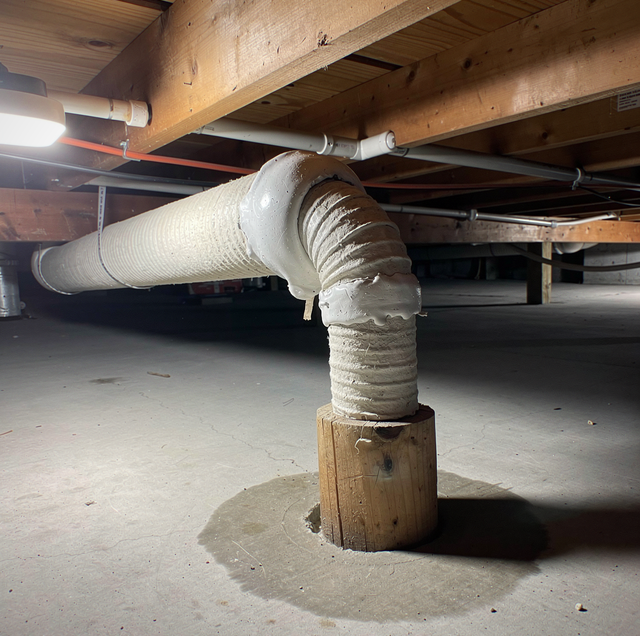
The estimate walk on an older house tends to pause in the same spot. The plumber crouches at the crawlspace hatch, puts a light down the joist line, and stops where the old hot-water pipe passes an elbow. The wrap thickens there into a hand-formed white lump with a chalky surface and a paper skin lifting at the seam. For a moment the pipe stops being the subject. What matters is what the covering is made of and whether anything on the job will touch it.
Asbestos in a house is not dangerous because it is present. It is dangerous when it is in the air. A wrapped pipe that has sat still for sixty years has sat next to the laundry, the bikes, and the furnace filter without putting much of anything into the room. What changes that is mechanical: cutting, drilling, sawing, scraping, crushing, or dragging something across it. A whole-home repipe is a planned, systematic version of those actions, aimed at the specific parts of a building where the material was used. So the question does not arrive with an inspection or a sale. It arrives with the route the new pipe has to take.
Quick Answer: Asbestos releases fibers when it is disturbed or already deteriorating, not when it is sound and left alone. A repipe route runs through the assemblies where it was used, which is what puts the survey ahead of the first cut.
The Crawlspace and Basement, Where the Old Lines Already Run
This is the material a repipe is most likely to actually meet. Old hot-water supply and heating lines were insulated with corrugated asbestos paper wrap, preformed sections on the straight runs, and block insulation that was roughly 15% asbestos by weight. At every fitting the preformed pieces stopped, so a wet insulating cement was packed on by hand and troweled smooth around the elbow, the tee, and the valve. That hand-applied fitting cement is the white chalky lump, and it is the part that degrades first. The same family of materials shows up on the equipment those lines serve, as jacketed insulation on an old boiler or storage tank and as wrap on ducts sharing the joist bays, within arm's reach of the water heater connections a repipe has to remake.
It is also friable, which is the term used to describe how a material is treated. Friable means it can be crumbled by hand pressure when dry, so it gives up fibers readily with very little force. A coil of tubing pulled along a joist bay, a shoulder passing under a low run, a drill lifted out of a hole, or a boot set down in the wrong place is enough contact to matter, and the crawlspace is where a technician works within inches of that covering for hours. Why the old line is failing in the first place, whether it is steel corroding from the inside or polybutylene splitting at the fittings, is a separate question from what is wrapped around it.
The Wall Cavities Between the Fixtures
The drywall panel itself is not the concern. The seams are. Taping and patching compounds were made with asbestos as a bulking and crack-resisting ingredient well into the 1970s, and skim coats and some textured plasters carried it too. A repipe cuts small openings near fixtures, at stud bays, and in closets, and those openings routinely land on a taped joint or pass through a plaster wall that was finished with a troweled coat.
The volume of dust from a four-inch hole is small, but a saw drawn through a taped seam puts fibers into the air of a room where people sleep as reliably as a large demolition does. This is also where the age question is most often misread. A build date is a screen that tells you whether to ask, not an answer about what is there. A later date lowers the odds without clearing the house, because stock already on shelves and in contractors' vans kept getting used for years after production stopped, and a remodel can put old material into a newer wall.
The Attic, Where the Line Crosses Overhead
Loose-fill vermiculite insulation is pebbly rather than fibrous, pours instead of matting, and reads as gray-brown or silver-gold flecks lying between and over the joists. Most of what was sold for attic use came from a single mine whose ore carried asbestos, which is why any loose-fill vermiculite is treated as if it contains asbestos and left alone rather than disturbed.
A repipe that runs a trunk line across the attic disturbs that material directly rather than incidentally. Knees and boots go into the joist bays, tubing is pulled through the fill, and the fill gets pushed aside to reach a top plate or a fixture drop.
If loose-fill has already been stirred up, stop, leave the space, and close it behind you. Do not sweep or vacuum, which puts fibers back into the air. Get a professional assessment before anyone goes back in.
The Ceiling Where a Line Drops Through
Spray-applied textured and acoustic ceiling coatings were applied to residential ceilings throughout the middle decades of the last century, and stock already in circulation kept going up for a while after production ended. The coating is soft and lightly bound, so it gives up material with less force than a hard plaster finish does.
A line dropping to a fixture below requires a hole through the ceiling, and an access cut for a connection requires a square of it to be removed. Either one breaks the coating at the edge, and the cut edge is where a soft finish sheds. A ceiling that was scraped and repainted at some point is not evidence either way, because a previous owner's work leaves no record in the surface that remains.
The Bathroom and Laundry Floor
Vinyl asbestos tile most often appears in nine-inch squares, a period size that predates the twelve-inch standard, though twelve-inch tile of the same era exists as well. Under it sits black cutback adhesive, an asphaltic mastic that is frequently the asbestos-containing layer even in floors where the tile itself is negative. Older sheet vinyl is the same story in a different form: the vinyl wear layer on top is not the issue, and the felt paper backing underneath is where the fiber sits.
All of it is non-friable. Intact tile does not crumble under hand pressure and releases very little while it is left whole and bonded down. What changes the category is cutting, drilling, sanding, grinding, or snapping it, and a repipe reaching a tub trap, a shower valve, or a laundry box opens exactly those floors. The plumber's work turns a non-friable material into a friable one, which is why this belongs on the list before the job rather than after it.
The Service Line Outside and the Vent It Passes Indoors
Buried water mains and some service lines were run in asbestos-cement pipe, sold for decades under the name Transite, and the same product was also used as flue and vent pipe indoors. Both are non-friable and stable while intact and in place. Both are also things a job disturbs on purpose: a service line replacement excavates and cuts the old pipe, and a utility-room repipe works within arm's reach of the flue serving an old water heater.
An asbestos-cement main is handled by the people licensed to handle it, using their own methods and their own containment, not by whoever happens to be holding the saw that day. A gray, unusually thick-walled pipe with no metal ring to it is easy to mistake for concrete and easy to cut without a second thought.
What a Survey Actually Involves
The person doing it is not the homeowner. Taking a sample means removing a piece of the material, which is the same disturbance the entire question exists to prevent. A qualified inspector walks the building against the intended scope of work, identifies each distinct suspect material, takes a small number of samples under controlled conditions, and returns a written report naming what is present, where it is, and what condition it is in. Condition carries as much weight as presence, because damaged material is handled differently from sound material. The plumbing crew is not the party responsible for answering this. A crew can stop when it finds something suspect and can plan a route around it; identifying the material and clearing it are separate accredited work.
Appearance settles nothing on its own. Two identical-looking ceilings from the same decade can come back with opposite results, and no amount of experience reading a joint or a floor substitutes for the analysis. Working out how old the plumbing itself is asks the same age question of a completely different material, and answers a different one.
Give the inspector your plumber's planned route before the survey, not the house as a whole. A survey scoped to the actual attic run, wall openings, and floor cuts collects fewer samples and answers the question the job asks.
What a Positive Result Does to the Job
Abatement is separate work with its own crew, its own containment, and its own clearance step, and the plumbing does not proceed through that area until it is finished. The order becomes survey, then abatement where it is needed, then repipe. Sometimes the answer is not removal at all, because a line that can be moved so it never crosses the assembly leaves nothing to take out. What decides between the two is where the material sits relative to where the pipe has to go.
The rules themselves are not a plumber's to state. Requirements for testing, for notification, and for who may perform the work differ by state and by locality, and the local authority, together with a licensed abatement contractor, are who answer that for a specific address. What is consistent is why the material is regulated at all: it is a known human carcinogen, associated with asbestosis, lung cancer, and mesothelioma, and the regulation follows the fibers rather than the mineral sitting in a wall. The staging of the work itself, what gets opened on which day and what gets closed back up, is planned around whatever the survey returns.
Frequently Asked Questions
The standard method for bulk building materials is polarized light microscopy, which identifies the fiber type and estimates what share of the material it makes up. Federal rules treat a material as asbestos-containing if it contains more than 1% by weight, and some states regulate construction work at a lower threshold, so the number that applies to an address comes from the local authority. Some materials defeat the routine read: floor tile and cutback adhesive bind their fibers tightly and mill them fine, so a point count or electron microscopy is used on those instead.
Yes, in small amounts and in specific parts. Flat gasket sheets at flanged connections, packing wound around older valve stems, and some pump and fixture gaskets were made with asbestos fiber for heat and chemical resistance, and the gasket material was among the last uses to remain in production. Those parts are bound and non-friable, and a repipe, by definition, removes and replaces them.
An accredited asbestos building inspector, working under the federal accreditation framework on which most state programs are built. States differ on who they license, how they certify, and what a residential survey has to include, so the local authority is the one that names the accepted credential for a given address. A plumber is not that person, and neither is a contractor who says a wall looks fine.
Sometimes, and it is worth raising early. A line planned through a skim-coated plaster wall can often run in an interior partition, a closet chase, or a cabinet bay instead, and a fixture drop can shift a few feet to land in plain drywall. An attic crossing has no equivalent detour, and rerouting is never a substitute for knowing what is actually there before the plan is drawn.
Analysis is usually the short part, with bulk samples typically returning in a matter of days and quicker turnaround generally available. What moves a schedule is abatement, which brings its own setup and clearance step before the area is released back. Booking the survey at the estimate stage, rather than on the morning the crew arrives, is what keeps the two from stacking on top of each other.
No. A result speaks only for the homogeneous material it came from, meaning one material of one type, applied at one time, in one area. A negative on bathroom floor tile says nothing about kitchen sheet vinyl, hallway taping compound, or crawlspace pipe wrap, and multiple samples of the same material are routine because one sample can miss what a batch contained. A survey report reads as a list of assemblies, each carrying its own answer.
Book a repipe assessment that maps the route first — see which walls, ceilings, and attic runs the job will touch before anything gets opened. PEX Plumbing & Repiping serves Portland, Beaverton, and Tigard. Call (971) 232-3079.
