
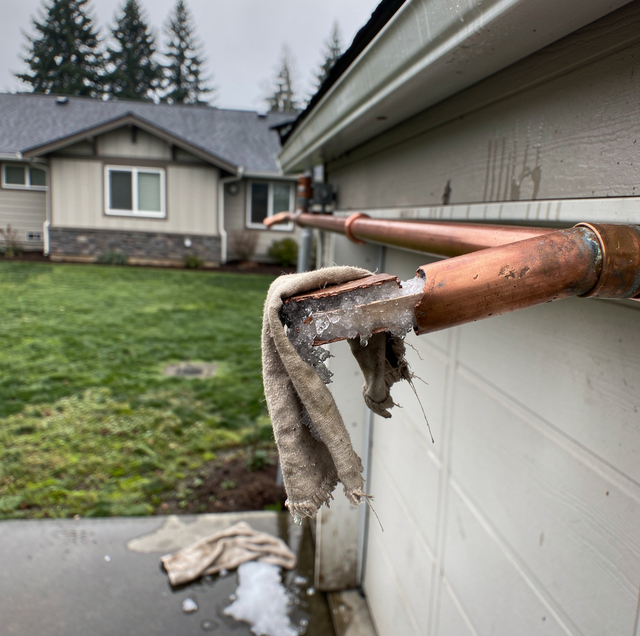
"PEX can't freeze" is a line homeowners repeat after a repipe, and it rounds up the real property of the tubing into something simpler. PEX can freeze. Water inside it turns to ice at the same temperature as water inside any other pipe. What changes is what happens next, and that difference is why repipe crews use PEX in houses that have already lost a section of copper or galvanized to a cold snap. How copper, galvanized steel, CPVC, and PEX respond once ice starts forming inside them:
| Material | What Freezing Does To It | Where It Fails |
|---|---|---|
| Copper | Rigid walls give the expanding ice nowhere to go | A straight run or a soldered joint splits under the pressure |
| Galvanized steel | On an older line, internal corrosion has thinned the wall before ice adds load | The thinnest corroded spot gives way first |
| CPVC | Turns brittle in cold and can't flex to absorb the expansion | Can crack along the pipe wall |
| PEX | Expands slightly outward, giving the ice room to form | A crimped, brass, or otherwise rigid fitting, where the pipe can't stretch |
The Physics of Ice Inside a Closed Pipe
Water is one of the few common substances that expands when it turns solid, gaining roughly nine percent in volume as it freezes. Inside an open container, that expansion pushes upward. Inside a pipe with a closed fixture at one end, an ice plug forms first at the coldest point along the run, sealing off a section of water on either side. As the temperature keeps dropping, that trapped water keeps trying to expand, and because it is sealed in on both sides, the pressure has nowhere to bleed off except into the pipe wall itself. That buildup, not the ice plug directly, is what eventually splits a pipe. It also explains why the break can sit several inches or even feet away from where the ice first formed: the failure happens wherever the wall is weakest along the pressurized section, not necessarily at the coldest spot.
Why PEX Flexes Where Copper and Galvanized Split
Copper and galvanized steel maintain a fixed internal diameter regardless of what is pushing against the inside of the wall. When trapped water tries to expand, a rigid wall resists until it can no longer, and the failure is sudden: a clean split or a seam that opens along the pipe. PEX is a cross-linked plastic tubing, and that molecular structure lets the pipe wall stretch outward under internal pressure and relax back down once the ice melts. Given a section of trapped, freezing water, PEX can expand its own diameter enough to absorb a meaningful share of the pressure that would otherwise have nowhere to go in a metal pipe. That wall flexibility is the whole mechanism behind PEX's freeze tolerance.
PEX's Weak Points in a Freeze
Flexibility is a property of the tubing itself, not of every part in a PEX system. Fittings are brass or rigid plastic, and neither stretches the way the surrounding tube does, so a fitting is where a freeze is most likely to cause damage, even in an all-PEX system. A crimp ring or a brass insert holds its shape while the tubing on either side tries to expand, concentrating stress at that joint. The other weak point is exposure. PEX that runs along an exterior wall, through a vented crawlspace, or across an unheated garage ceiling experiences a larger temperature swing than a line inside conditioned walls, and the longer and colder the exposure, the more time ice has to form a plug and pressure to build behind it. Sun exposure carries its own separate risk: ultraviolet light degrades PEX tubing over time regardless of temperature, so an exterior run also needs a UV-rated sleeve independent of any freeze protection.
Routing a Repipe to Keep Lines Out of Cold Spots
A repipe is the point where a house gets a real say in how much freeze risk it carries going forward, because the crew is choosing where every new line runs rather than working around whatever path the old pipe happened to take. Interior walls stay closer to room temperature than exterior walls, so routing supply lines through interior partitions rather than along an exterior wall keeps them away from the cold that reaches an exterior wall cavity. Attics, crawlspaces, and garage ceilings are the other cold spots, and a repipe can move a line down into conditioned space or add insulation and heat trace along any run that has to cross one of those zones. How much of that effort belongs in the plan depends on the winters the house sees. A hard freeze can burst an aging copper or galvanized line, and in a house that gets hard freezes, that is one more reason the old pipe comes out, with the new PEX routed so it does not inherit the same cold spots. Where freezes are uncommon, the old pipe's freeze risk remains low, and the case for repiping rests on other problems, such as leaks and corrosion. The routing choice is still made once during the repipe, and moving a line that sits inside a finished wall later can mean opening that wall again.
Handling a Line That Has Already Frozen
Never thaw any pipe with an open flame: a torch can melt PEX, scorch framing, or ignite insulation before the ice clears. A line that remains frozen is sent to a licensed plumber, who thaws it with flameless heat.
If a fixture stops producing water during a cold snap, the first move is to open that faucet and leave it open, so any water that does start moving has somewhere to go, and any pressure building behind the ice plug has an outlet. From there, gentle heat applied along the visible section of the pipe is the safe approach; concentrating heat on one spot risks turning trapped water into steam before the ice ahead of it has anywhere to release it. Electric heat tape is a reasonable tool for a line that keeps freezing in the same spot, but only tape rated for PEX; the wrong rating or a missing thermostat control can overheat and damage the tubing. A line that will not clear, or one where a wall or ceiling starts showing water, calls for a plumber before anyone tries to force it further.
Freeze Protection Beyond Pipe Choice
Pipe material sets the baseline, but the rest of a home's freeze protection comes from separate habits and equipment that apply no matter what the lines are made of. Keeping the heat on, even at a lower setpoint, protects every pipe in the house, whatever it is made of, since the goal is to keep the space around the pipe above freezing rather than fighting the cold at the pipe itself. Pipe insulation sleeves on any accessible run through an unheated space add a meaningful buffer, and sealing drafts that let outside air reach a wall cavity closes off the source of that cold in the first place. None of these steps replace a sound repipe, but they extend the margin any pipe, PEX included, has before a hard cold snap turns into a break.
Frequently Asked Questions
A pipe does not freeze the instant outside air drops below 32 degrees. It depends on how long the cold lasts and how exposed the run is: water inside a wall or crawlspace is buffered by the structure, so a line in an unheated space can freeze during a sustained hard cold while the same line rides out a brief dip.
Yes, and it works for a specific reason: sink cabinets against an exterior wall can sit outside the reach of a home's normal heat flow, so opening the doors lets warm room air circulate the supply lines instead of leaving them in a sealed, unheated pocket. Leave the doors open for the length of the cold spell, and move cleaning products stored under the sink out of reach if children or pets are in the house.
Yes. PEX's flexibility buys margin, not immunity, and a hard enough freeze or a long enough cold snap can still exceed what the tubing can absorb, particularly if ice forms in two places along the same run and traps water between both plugs with no direction to relieve pressure.
A hand-held hair dryer, kept moving continuously along the pipe rather than held on one spot, is a safe method for an accessible section. Start at the end nearest the open faucet and work toward the blockage, so that melting water has a clear path out rather than building pressure against a plug that is still solid farther down the line. A heat gun is a different tool: its output is hot enough to soften or scorch PEX, so it stays out of the job.
A frozen line can show up as no water or a noticeably weak trickle at one fixture, while others in the house still run normally, since the blockage sits in one branch rather than the whole system. Frost or unusual dampness on an exposed section of pipe, where you can see it, is another early sign worth checking before it turns into standing water somewhere.
It can. A slow drip keeps water moving through the line instead of sitting still, and moving water resists freezing longer than standing water does. The drip belongs on a faucet whose supply runs along an exterior wall or through an unheated space; on a single-handle faucet, setting the handle to the middle keeps both the hot and cold lines moving.
Ask for a whole-house PEX repipe routed away from cold spots — new lines run through heated space where the layout allows, with insulation on any run that has to cross a crawlspace, attic, or garage. PEX Plumbing & Repiping serves Portland, Beaverton, Tigard. Call (971) 232-3079.