
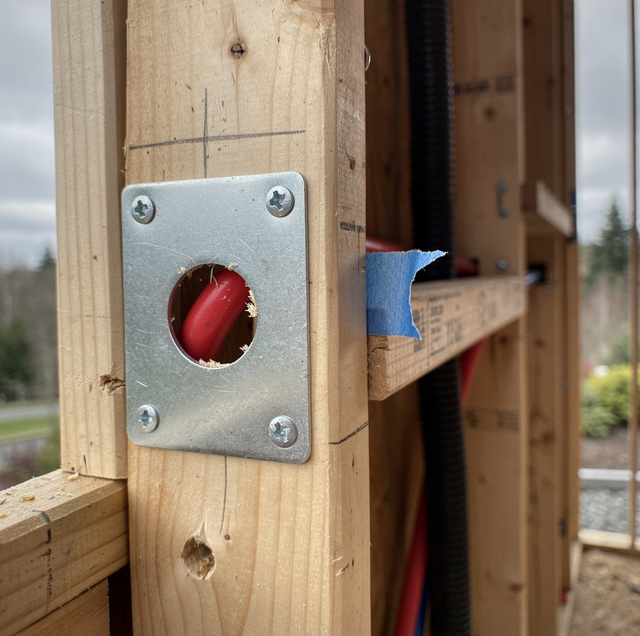
Midway through your repipe, the walls stand open, and the new tubing is visible for the first time and the last. Along one of those runs, screwed flat against the edge of a stud, sits a thin steel rectangle a couple of inches wide. Most homeowners walk straight past it. If you noticed, yours has a name and a job.
That part is a protector plate, and where you see one, somebody made a call about the pipe behind it. This article covers what the plate stops, how close the tubing has to sit to the face of the framing before your plumber reaches for one, and what you can check for yourself on the walk-through while the wall is still open.
What Those Small Steel Plates on the Framing Are Doing
The part you are looking at goes by several names on site. Plumbers call it a nail plate or protector plate, and manufacturer installation guides for PEX tubing call it a stud guard: a stud guard protects plumbing from being penetrated by nails or screws driven in later. The tubing runs through a hole bored in the framing, and the plate caps the outer edge of that hole.
It holds nothing and seals nothing. Every fastener driven into that stud for the rest of your home's life arrives blind: drywall screws first, then baseboard nails, cabinet screws, a shelf bracket, a television mount. Nobody holding the driver sees the pipe, including you. A plate proud of the wood stops the tip before it gets there, and there is one moment in the job when it can go on.
How Close the Pipe Sits to the Face of the Stud
Two practices point at the same target from different angles, and the order matters. Abrasion clips go at each hole, on some systems especially where PEX passes through metal studs, and nail protection plates belong wherever the tubing runs within 1-1/2 in. of the face of a stud or joist.
On some systems, the line is drawn somewhere else: any time a stud is breached, a stud guard goes in; a broader trigger than a measured distance: a hole through a stud, anywhere in that stud, calls for a guard. The plate also gets a size, overlapping the piping by 1 inch on each side, so the part is sized against the hole itself rather than the framing member. Put the two together, and you get something usable on your own walk-through: the shallower the hole sits and the more wood that came out of it, the surer a plate belongs there.
The distance matters because of what sits on the other side of the wood. A drywall screw runs a little over an inch, and a trim nail can be longer; neither is aimed. Both go wherever the framing is, and the framing is exactly where the tubing crosses. Where the pipe sits an inch and a half back from the face, a fastener runs out of length.
Protector plates go on while the plumber pulls each run, because fitting one afterward means a plumber has to cut open finished drywall over a cavity that may also carry live electrical wiring.
Which One Protects the Pipe: The Plate or the Abrasion Clip?
Both of them do, and they answer different problems. A plate stops something arriving from the room side. A clip stops the pipe wearing itself out against the framing, the slower failure and the easier one to miss, because nothing about it involves a mistake. Mistaking one part for the other is easy, and you will see both of them on your own run.
The second point is worth your attention. PEX expands and contracts with temperature changes, causing the pipe to move back and forth, and over several years, even that slight movement can wear a hole in the tubing, especially where it rubs against something abrasive.
So a clip guards the pipe against its own movement instead of against a fastener, and neither part stands in for the other. Manufacturer guidance adds a third item for a different framing type: use grommets when installing pipe through steel framing. If your walls are wood, you will see plates on the crossings; where the framing is steel, expect grommets too.
What a Skipped Plate Does to a Wall Years Later
A screw into PEX does not always leak straight away. Sometimes the fastener plugs the hole it made, and the wall stays dry for months while the tubing works against the shank every time hot water moves through it. By the time a stain shows on the ceiling below, the drywall, paint, and trim have all been finished over the spot.
That horizon is the whole reason the plate matters. Professional PEX installations have a service life of 50 years or more under normal residential conditions, and a repipe is planned for that duration. One screw driven in year three, into tubing nobody covered, ends a run decades early, and you find out from a ceiling.
What to Look At While the Walls Are Still Open
You get one window for this, and it closes when the board goes up. Walk the house with the runs exposed and follow a single line at a time, from the manifold or the main out to a fixture. Every place the tubing crosses a stud or a joist is a place to slow down and look at the edge of the wood.
Look for a plate at the crossings nearest the face of the framing, on your hot line and the cold. Look at the overlap, because manufacturer guidelines call for an inch of steel past the tubing on each side, and a plate with barely any metal beyond the hole is worth questioning. Look hardest at the crossings behind whatever gets fastened later: kitchen cabinets, tile backer, a towel bar, a mounted screen.
Then photograph what you found. A phone picture of each open wall is the only record of what sits behind the finished surface, and asking the crew for ten minutes before the board arrives is a reasonable request. Galvanized stud guards typically come in 16- and 18-gauge, three to six inches long.
Plates as a Signal of Workmanship on a Whole-House Repipe
Fitting a plate takes a plumber a few seconds and one hammer tap, and skipping it saves a crew almost nothing. The imbalance in that trade makes the part worth watching. A crew that plates every crossing in a house has a habit, and habit carries that quality through the parts of a repipe that nobody sees again.
A properly run whole-house repipe is code-compliant and performed with care to protect surrounding surfaces, and a professional crew manages the regulatory side of the job, including permit applications, inspection scheduling, and code compliance documentation. What a local inspector asks of your job stays between that inspector and your plumber, and manufacturer installation guides say as much about their own limits: they are meant as guides only, not a substitute for local plumbing codes.
So take the walk while the studs are still bare, because the record closes behind a sheet of gypsum. Ask about the crossings, look hard at the edges of the wood, keep the pictures. Fifty years from now, when somebody hangs a mirror and drives a screw home, everything depends on a strip of steel screwed to the edge of a stud.
Frequently Asked Questions
Not without opening the wall, which is why they go on while your walls are still framed. The plate is barbed on the back or screwed on, and it fixes to the exposed edge of a stud. Once your board is up, your plumber cannot reach that edge.
Yes, and your hot side carries one extra reason. Manufacturer data puts PEX-A movement at 1.1 inches per 100 feet for every ten degrees of temperature change, so a hot run in your wall shifts inside its hole in a way a cold run does not. Your crew plates both, and you can check both.
Nothing. It vanishes under the board, and a plate fitted flat leaves no ridge in your finished surface. A stud finder switched to metal scanning will pick one up, which is how anyone locates them later, and it is also why a picture hook that stops dead an inch into your wall has probably found one you never knew about.
The same trigger names both members, a stud or joist, and joists take fasteners the same way studs do. Subfloor screws go down through the sheathing into the top edge of the joist, and flooring nails and staples follow them soon after. If your tubing crosses a joist near that top edge, you want the same plate you would want in your wall.
That depends on the crew, so ask before the drywall arrives instead of after. A well-run whole-house repipe provides documentation for warranty purposes and future property transactions as part of complete, start-to-finish service, and a set of pre-drywall pictures sits naturally in that file. A photograph of a plate at one of your crossings outlasts anything you can remember about it yourself.
Then leave your wall alone. Opening a finished cavity on a hunch does more damage than it prevents, and what lies behind it may carry both wiring and pipe. What you can do takes no tools: pull the paperwork from your repipe, ask the plumber who did the work which crossings were plated, and file the answer with your house records. Manufacturer guidance is worth remembering too, because the list runs wider than nails: it directs installers to use steel plate protectors to protect PEX piping from damage from drywall, paneling, nails, or screws.
Book a pre-drywall walk-through of your repipe — ask the crew to show you every point where the new tubing crosses a stud or joist, and what went over it before the wall closed. PEX Plumbing & Repiping serves Portland, Beaverton, and Tigard. Call (971) 232-3079.