
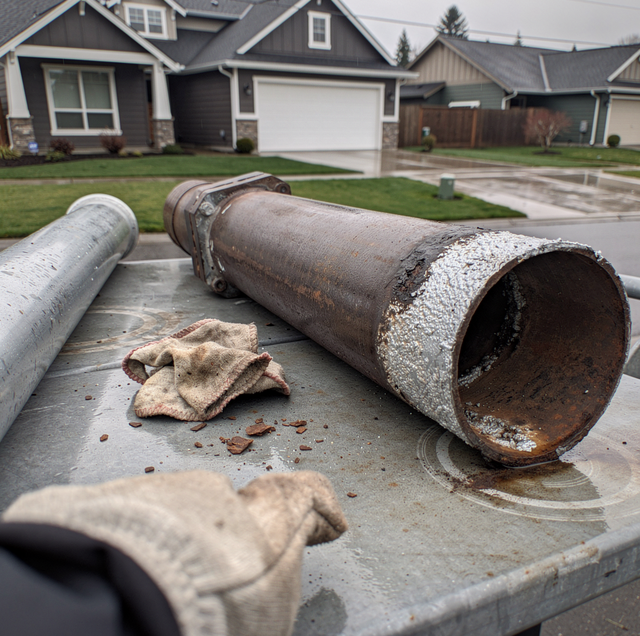
Two homes on the same block can run water that looks identical from the tap and still treat their pipes differently. Acidity, hardness, disinfectant levels, and how fast the water moves through the line are all separate traits, and each one leans on a different weak point depending on what the pipe is made of. Zinc-coated steel, copper, and PEX plastic each answer to the water in their own way, so the same glass of water that leaves one material alone can be quietly working against another. That is the case for treating water chemistry as part of the material decision, not as an afterthought. Four of those traits line up against a galvanized wall, a copper wall, and a PEX tube like this:
| Water Trait | Galvanized Steel | Copper | PEX |
|---|---|---|---|
| Low pH / acidic water | Strips away the protective zinc layer, exposing bare steel underneath | Dissolves the thin oxide film that shields the metal, opening the door to pitting | Chemically inert plastic; there is no coating or oxide layer for acidity to strip |
| Hard water with scale | Mineral scale layers over the rusting interior, narrowing the bore further | Scale can coat and partly mask corrosion happening underneath it | Smooth, non-reactive bore gives scale little to grip onto |
| High chlorine or chloramine | Adds oxidizing stress that speeds zinc depletion | Feeds the pitting reaction that perforates the pipe wall from the inside | Rated for a set level of chlorine exposure in hot water; the tubing's rating, not its plastic, is what answers this trait. |
| Dissolved oxygen and high flow velocity | Speeds internal rust at turbulent spots | Erodes the protective film at sharp turns and narrow-diameter runs (erosion corrosion) | Flexible routing needs fewer fittings, and the fittings that remain are chosen for the water |
What "Aggressive" Water Does to Metal Pipe Walls
A metal pipe's wall faces the water through a barrier. Galvanized steel carries a zinc coating meant to take the abuse instead of the steel beneath, and copper relies on a thin oxide film that forms on its interior surface, blocking the metal beneath from direct contact with water. Calling water "aggressive" means it is chemically working against one of those two barriers. Low-pH water is the clearest case: acidic water dissolves the oxide film on copper and eats into a zinc coating, and once either barrier is breached, the base metal underneath is exposed directly to everything else in the water.
High chlorine or chloramine push the same door open from a different direction. Disinfectant residual is an oxidizer by design, since that is what lets it control bacteria in the distribution system, and that oxidizing action does not stop at the pipe wall. On copper, that attack ends in a pinhole pattern that covers it on its own; on galvanized steel, it adds to the chemical load working against the zinc. Neither effect shows up as a single event. Both accumulate, so a pipe wall that looked sound for years can reach a point where the coating or film is gone, leaving the exposed metal open to corrosion.
How Scale Builds and Narrows a Pipe
Hard water carries dissolved calcium and magnesium, and those minerals do not always stay dissolved. As water moves through the plumbing and responds to changes in temperature and pressure, some of its mineral content comes out of solution and settles onto whatever surface it touches. On the inside of a pipe, that settling becomes scale: a layer that builds on the wall and, given enough time, narrows the space left for the water to flow through.
No pipe material is completely immune to scale forming somewhere in the system, but the interior surface matters. A metal pipe that is already corroding gives scale a rough, uneven surface to catch on, and the two problems compound each other: corrosion roughens the wall, scale sticks to the rough spots, and the buildup traps more corrosion underneath it. A smooth, chemically stable bore does not offer scale the same foothold, so mineral content that would layer onto a corroding metal wall has much less to hold onto passing through it.
How Disinfectants Act on Each Material
Every material in this comparison is expected to sit in water carrying a disinfectant residual, since that is standard for water delivered through a public system. The difference is how each one responds to it over years of exposure. For galvanized and copper, disinfectant is an additional chemical stress on top of whatever pH and mineral content the water already carries, and it acts on the same protective layers described above. Plastic tubing is rated for how much hot, chlorinated water it can carry because an oxidizer acts on the plastic's stabilizers rather than on a metal surface.
Heat changes how active all of this becomes. A water heater tank holds its contents at a sustained higher temperature, and that steady heat pushes the chemistry in the tank further along than a cold line moving straight through ever sees, so a hot-water loop and a cold-water loop are not experiencing the same conditions even though they started as the same water at the meter. That gap is worth keeping in mind whenever a symptom shows up on one side of a home but not the other.
Why a Water Test Comes Before the Pipe Choice
Every trait in the table above varies by system, by season, and by what has happened upstream of the meter, so no one can tell a homeowner what their water is doing to their pipes without checking it directly. A water test reads a short panel of numbers rather than a single verdict, and each one answers a different part of the material question: how acidic or alkaline the water is, how much dissolved mineral it carries, how strong the disinfectant residual is, and how much oxygen it carries. Reading those together, rather than guessing from a stain or a slow drop in pressure, tells a specialist which traits are at play for that specific home. The same test also catches traits that would not matter at all to a metal pipe but would change what a plastic material needs to be rated for, and traits that matter to metal but not to plastic.
That test comes before the pipe gets picked, not after, because it is the input the decision runs on. Skipping it means choosing a material based on a general reputation rather than on what the water traveling through the home carries.
How the Material Gets Chosen for a Repipe
Once the water results are in, a repiping specialist reads them alongside the physical evidence already sitting in the walls: how far the existing pipe's corrosion or scale has progressed, whether leaks have already started, and what the home's layout asks of the new run. Aggressive water chemistry narrows the decision more than it dictates a single outcome, since it weighs against keeping a corroding metal system and in favor of a material and fittings rated for what the test found, while other factors specific to the home still shape how the job gets done.
PEX takes the metal out of the equation: there is no zinc coating to strip and no oxide film to dissolve, so acidity and scale no longer attack the pipe wall. Chemistry does not vanish from the decision. Disinfectant in hot water is the condition PEX tubing is rated for, and the brass fittings in a PEX system are metal, so the water test still determines which tubing rating and which fitting material go in.
Cutting into a supply line releases water at full service pressure and floods the wall cavity until the main is found, and treatment chemicals added to the supply reach every tap in the house. Both jobs stay with a licensed plumber.
Frequently Asked Questions
Yes. Brass fittings are metal, and aggressive water can leach zinc from some brass alloys, leaving a weak, porous fitting; dezincification-resistant brass or plastic fittings are chosen where a test indicates aggressive water.
It can shift the picture rather than leave it unchanged. A softener that strips hardness minerals out of the water also strips out some of the scale-forming content that, on an old metal pipe, had been partly coating and shielding the corroding interior. Removing that mineral layer can leave the underlying metal more exposed to the water than it was before softening started, which is one reason a newly softened system can behave differently around old metal pipe than the untreated water did.
It can, because a corroding metal surface sheds trace material into the water as it deteriorates, and some of it shows up as a metallic taste or tint. Plastic tubing has no metal to shed, so it doesn't impart a metallic taste. A taste change that develops over time, rather than one that was always there, can come from what the existing pipe is doing or from a change in the source water; a test can separate the two.
Yes, and a test taken only at an interior fixture will not separate the two. Water can pick up additional characteristics from whatever it passes through before reaching a home's interior plumbing, including the condition of the service line itself, so a reading taken at the kitchen sink reflects that whole path, not only what left the treatment system. That distinction matters when the goal is to decide what the home's interior pipe needs to be rated for.
Not at the meter. The old metal pipe added trace metal to the water as it corroded and reacted with acidity and disinfectant; PEX tubing adds none, so that contribution stops, and the brass fittings are the metal left in the run. The water arriving at the meter is unchanged.
Yes. Once the old metal pipe is out of the system, a test no longer needs to separate what the source water carries from what a corroding pipe was contributing on its own; any trace-metal reading that used to show up in a sample now traces back to the service line, the brass fittings, or the fixtures rather than the tubing, since PEX tubing has no metal to shed.
Arrange a whole-house PEX repipe — the existing pipe is inspected, and the new tubing and fittings are matched to your water test results and the home's layout. PEX Plumbing & Repiping serves Portland, Beaverton, and Tigard. Call (971) 232-3079.