
Signs It’s Time to Replace an Aging Water Heater, Not Repair It
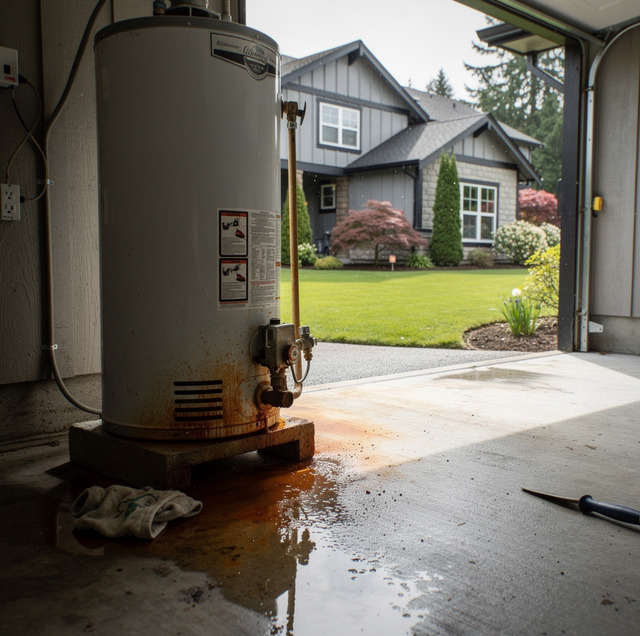
You probably judge your water heater by one test: does your shower still turn hot? If so, you assume your tank is fine and quickly move on with your day. That test tells you almost nothing about what is happening to the steel and the lining inside the tank, the part you never see.
A tank can pass your test for months after it has already started failing, and the same tank can throw a warning sign years before it actually quits on you. Each sign below points at something specific happening inside your tank, not a vague sense that it is "getting old." Once you know what a sign means, you know whether it is worth a repair call or a replacement conversation.
Why the Ten-Year Mark Is a Warning, Not a Deadline
A conventional tank water heater typically lasts 8 to 12 years, depending on the water running through it, how often it gets serviced, and how hard it works day to day. That is the range plumbers who replace these units see most often, not a fixed number stamped on any single tank.
The mechanism behind that window is the anode rod: a sacrificial metal rod bolted to the top of the tank so that corrosion attacks it first, sparing the steel tank wall. As long as the rod still has metal on it, it keeps giving up electrons to the tank. Once it is reduced to a bare wire, the tank's own steel becomes the next target for corrosion, and the clock on the tank shell starts running. Magnesium and aluminum are the two metals most residential tanks use for that sacrificial rod, and both work the same basic way: whichever metal corrodes fastest gives up material so the underlying steel in the tank does not have to.
That is why age by itself is a starting point and not a verdict. Two identical tanks installed the same week can reach that consumed-anode point at different times depending on how aggressive the water chemistry is and how much the unit gets flushed. Treat the eight-to-twelve-year window as the point where every other sign in this article stops being background noise and starts being a question worth answering. A three-year-old tank rumbling is a different conversation than a fourteen-year-old tank doing the same thing. Neither age stands entirely alone here.
What Rumbles Inside an Aging Tank?
A popping, cracking, or rumbling sound coming from the tank during a heating cycle is sediment, almost always. Minerals in the water settle out at the bottom of the tank over years and build into a hardened layer sitting directly between the heat source and the water above it.
On a gas unit, the burner fires under that layer, and water trapped underneath it flashes into steam pockets that force their way up through the sediment crust. Each pocket collapsing against the layer is what you hear as a pop or a rumble. On an electric unit, the lower heating element sits partly buried in that same layer, and it has to work through insulating sediment to reach the water it is supposed to heat, which produces a duller knock, not a sharp pop.
Neither sound is dangerous on its own, but both indicate the layer has already thickened to a point that changes how the tank behaves. A thin coating of sediment is normal in almost any tank a few years old. A layer thick enough to produce audible popping has been building for a while, and it is now doing two things at once: making the unit work harder to heat the same amount of water and insulating the tank's lower section from the sensor and burner that are supposed to read it accurately. The louder the popping gets over a season, the thicker the trapped layer has probably grown, since a thin coating barely disturbs the water above it, while a hardened crust traps steam pockets large enough to be heard clearly through the tank wall.
A single flush can knock loose a thin layer. A crust that has hardened over years often will not break up the same way, and a plumber checking a noisy tank is checking whether flushing still helps or whether the sediment has already outlasted that option.
Why Hot Water Runs Out Faster Than It Used To
Two separate things inside an aging tank can make hot water run out sooner, and they are not the same problem. The first is the sediment layer from the section above: enough of it sitting in the bottom of the tank physically displaces water, so a tank rated for fifty gallons might be heating and holding noticeably less by the time the layer is thick.
The second is the dip tube, a plastic tube that carries incoming cold water down to the bottom of the tank, where it mixes with the hot water already sitting near the top. A dip tube that has cracked, softened, or broken off partway down releases that cold water near the top of the tank instead, where it mixes straight into the hot water headed for your shower. The tank still has hot water in it, but a good share of what leaves the outlet is now diluted with water that never reached full temperature.
You can often tell the two apart by how the shortfall shows up. Sediment loss tends to arrive gradually over months as the layer grows. A failed dip tube tends to show up sooner, sometimes within a single week, because the plastic fails all at once rather than eroding slowly. Either way, the fix is not a bigger tank; it is finding out which part inside the one you have has actually failed. A plumber checking this can run a simple temperature reading at the tap over a few minutes, watching how quickly the incoming cold water reaches it, without ever opening the tank itself.
What Rust-Colored Water Is Actually Telling You
Rust-tinted water at the hot tap, with the cold tap running clear, usually traces back to the tank itself, not the pipes: once the anode rod inside is fully consumed, the tank's steel wall becomes the thing left absorbing corrosion, and iron from that corrosion sheds into the water passing through. Treat it as one sign among the others here, not the whole picture; a tank can be well past due for replacement on age and sediment alone with water that still runs clear.
One lookalike is worth ruling out before you write the tank off: a corroded threaded fitting where the water lines connect at the top can rust on its own and tint the water coming out of the hot tap. A plumber can check those fittings from outside the unit, and replacing a corroded fitting is a repair, not a replacement.
Why a Damp Base Means the Tank Itself Has Failed
A puddle collecting at the base of the tank, distinct from condensation on the outside of the tank in cold weather, usually means water is escaping from inside the tank shell, not from a fitting a wrench can reach. Corrosion that has worked all the way through the steel at a seam or at the bottom typically weeps slowly at first, then steadily, because the failure point is only getting wider with time.
An aging tank's water is scalding, so leave the drain valve and the relief-valve lever alone: a plumber can drain and inspect it instead of testing it.
That steady base leak is distinct from the occasional discharge at a nearby floor drain, which is usually the temperature and pressure relief valve doing its job during periods of higher tank pressure, not a sign that the tank shell has failed. A base leak does not stop or heal on its own, and once the tank shell itself has been breached, no repair puts steel back where corrosion removed it.
When a Repair Stops Making Sense
Every sign above can, in isolation, sometimes be addressed with a targeted repair: a flush for sediment, a new dip tube, an anode swap while there is still tank left to protect. What changes the calculation is how many of them show up together on a tank that has already passed the typical service window. A ten-year-old unit with rusty hot water, a slower reheat, and an occasional rumble is not three separate small jobs; it is one tank near the end of what a sacrificial anode and a steel shell can be asked to do.
One issue off that list gets handled differently regardless of age. If the unit burns gas and any part of the exterior venting or the connector running from the draft hood shows rust, looseness, or a gap at a joint, that is not a wait-and-see item, and it is not a do-it-yourself fix: a plumber or a qualified appliance technician needs to inspect and correct the vent path before the burner runs again, because a compromised flue can send combustion byproducts, including carbon monoxide, into the house and not out through the vent that is supposed to carry them off. Pushing a rusted vent section back into place or wrapping it and relighting the unit yourself is not a fix; it only hides the problem until someone is breathing the result.
Frequently Asked Questions
On the manufacturer's data plate near the top of the tank, usually inside the serial number, not a separate date. Most brands encode the month and year into the first few characters, so a plumber can decode a worn plate on your unit for you.
Yes. A leak at a welded seam or a factory joint can open before the anode is fully consumed, since the failure is a mechanical break rather than corrosion working through the tank wall. You can have a clear-running tap at your sink and still have a tank that needs to be replaced.
Often, yes. A pump that keeps hot water moving through your loop around the clock puts the tank through more heating cycles than one that only reheats when you draw hot water, and it keeps the water inside hotter for more of the day, so if your home runs one, expect the signs sooner.
Mostly, but electric tanks add their own signs. An electric unit heats with an upper and a lower element: if you only ever get lukewarm water, the upper one may have failed, while your hot water fading within minutes can point to the lower one. Either one is a replaceable part, not a verdict on yours.
ENERGY STAR's installation guide for heat pump water heaters recommends routing the discharge line within 6 inches of a floor drain so that released water does not contact people or electrical parts. Your tank may differ, but the reason is the same: the line is there to direct scalding water down and away from you, not out across your floor.
Ask one question before the next repair: does it touch the steel shell, or only a part attached to it? A new dip tube, element, or thermostat fixes that part and leaves your tank's corrosion where it was, so on a unit past its window you are keeping a failing shell in service. Plumbers who replace these units list frequent repairs alongside age and rust as signs of replacement, so check your records: if your last two calls were on this tank, ask your plumber whether a third makes sense for you.
Get an aging water heater checked before a small sign becomes a flood — a plumber can check the anode, the sediment, and the shell in one visit and tell you plainly what it needs. PEX Plumbing & Repiping serves Portland, Beaverton, and Tigard. Call (971) 232-3079.
