
Failing CPVC Pipe: The Signs That Show Up Before It Splits
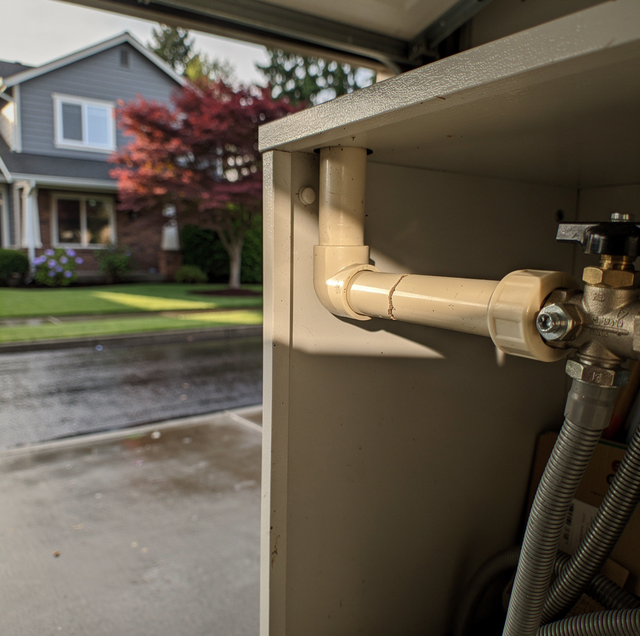
The stub coming out of the wall under your kitchen sink is cream, or tan, or something close to a pale butterscotch, and it is rigid. Put a flashlight on it at a low angle and sight along the top of the run, past the stop valve, back toward the cabinet wall. What you are looking for is a hairline: a single thread of a line running with the pipe rather than around it, visible only when the light rakes across it. On a hot line, start within a few inches of a fitting. That pipe is CPVC, and a hairline in it is the first visible stage of a fracture that has been growing from the inner wall outward.
How Do You Know You Are Looking at CPVC?
CPVC comes in one family of colors: cream, tan, and sometimes a pale gold; it is rigid. Press a horizontal run between hangers, and it will not give the way flexible tubing does. Your fingernail on it gives a hard flat click with no ring behind it.
The joints settle it. CPVC is solvent-welded: the pipe seats in a tapered socket with cement, and the two surfaces fuse into one piece of plastic. At a joint, you see a smear of orange or amber cement at the hub and nothing mechanical, no crimp ring and no solder fillet.
Then read the print line on the run in front of you. Every length carries type running along it: a manufacturer name, the nominal size followed by CTS for copper tube size, SDR 11, and the pipe's pressure-rating standard. A pressure rating appears on that line twice: once at room temperature and once at hot.
None of this needs a wall opened. Look under your sinks above the stop valves, at the water heater, along a basement ceiling. Sorting galvanized from copper from polybutylene, and whether any of it is original to the house, is a separate exercise. Build era narrows things: CPVC spread as a copper alternative through the 1980s and 1990s, and turns up again in houses re-plumbed out of polybutylene.
Why an Aging CPVC Line Splits Instead of Weeping
New CPVC has enough ductility to deform locally before it parts. A wall under hoop stress from house pressure yields around a flaw, blunts it, and holds. That property produces the failure a homeowner expects: a weep, a stain on the cabinet floor, a damp patch in the drywall that grows for a week.
CPVC gives that property up. It is a rigid amorphous thermoplastic, and two things work on it. The polymer densifies as it sits, which raises stiffness and cuts the strain the wall absorbs before it cracks. And the inner surface, in contact with hot water carrying an oxidizing disinfectant residual, undergoes chain scission, leaving a thin, degraded layer that is still less ductile than the wall behind it.
A material that cannot deform ahead of a flaw propagates the flaw. So an aged CPVC failure is a crack, and a crack in a pressurized pipe runs along the axis, because the hoop stress pulling the wall apart circumferentially is twice the stress pulling it lengthwise. That is why you get a split, and why it can be several inches long the moment it appears.
Your warning, if you get one, is the hairline: the crack before it has worked through to the bore.
Which Runs Give Out First in the House?
Hot runs in your house go first, and the two reasons work in sequence: one has applied from the day the pipe went in, the other accumulates on top of it.
The first is on the print line. A CPVC pipe's allowable pressure at room temperature and at hot-water temperature differ significantly, with the hot figure a small fraction of the cold one. Your house pressure does not drop between the two lines, so a hot run works at a far larger share of its rating while the cold run beside it sits well inside its margin.
The second is chemistry. Chain scission is a rate process, and rate processes run faster hot. A hot line accumulates the same degradation in less calendar time than the cold line beside it on the same water.
Then look at which hot runs. The first few feet off the water heater see the highest temperature in the system. A recirculation loop holds hot water in the pipe continuously instead of for the two minutes a tap runs. A length that has taken direct sun through a gable vent carries ultraviolet exposure on top of the heat, which chalks the surface and costs it toughness.
An aged CPVC hot line can open under ordinary house pressure and release water at the heater's set temperature: a scald at the cabinet door, a flood inside the wall. Check the two pressure ratings on your own pipe's print line.
The Chemicals That Crack CPVC From the Outside
Environmental stress cracking is a real failure path for CPVC, and it stays under-known outside the trade. A rigid polymer under sustained tension will craze and crack in contact with certain chemicals, at stresses far below what would break it dry. The chemical lowers the stress at which a crack starts, and pressure does the rest.
The tension is already there: hoop stress from house pressure, plus bending stress anywhere a run was sprung into place between two fixed points.
Start with plasticized vinyl, the contact you can find without tools. Vinyl tape wrapped on a line, a vinyl-jacketed cable across it, a vinyl-coated hanger clamped to it: the plasticizer migrates into the CPVC wall at the contact patch, and the crack starts there. The rest arrives with a job rather than sitting in your wall already: petroleum-based thread sealants and cutting oils at a threaded transition, some spray polyurethane foams when a cavity is insulated around a line in place, some firestop caulks.
So look at your own runs where a wire crosses a line, where tape is wrapped, where foam was sprayed against the pipe. And do not flex an aged line to test it: bending a wall that has lost its ductility starts the crack you came to find.
Where the Crack Starts on a Fitting
Picture a CPVC fitting cut in half, and the wall is not one thickness. The socket is a cup, thick at the hub where it holds the pipe, and thinner in the body past the bottom of that cup. The change in section at the base of that socket concentrates stress, and in a brittle material a crack starts at that concentration.
Assembly can put a flaw in that same ring. Cement that pools in the bottom of a socket stays wet long after the thin film on the sidewalls has set, and it goes on softening the pipe wall it sits against.
So a split at a joint begins under the fitting, travels out into the hub, and then back along the pipe, with the part you can see arriving last.
A half-inch CTS CPVC fitting takes about half an inch of pipe into its socket: the minimum socket length for that size is 0.500 inch, and the same fitting design sets the depth for every other size. Measure that half inch back from the face of a hub on an exposed hot run and put your light on that ring. Run a fingernail around the pipe there: what you are feeling for starts at the base of the socket, under the fitting, and reaches daylight last.
Frequently Asked Questions
No. Both come from the same base polymer, but CPVC is post-chlorinated, which raises the chlorine content of the finished material from roughly 57 percent by weight to 63 to 67 percent. That extra chlorine raises the temperature at which the material softens, and that is what lets CPVC carry hot water at all. The white schedule 40 PVC in your house is a drain, waste, and vent pipe or a cold-only line, and it is not rated for your hot supply.
Not as a calendar number. The rating in the print line comes from long-term hydrostatic pressure testing against a national testing standard, which establishes how much stress the material holds for how long at a given temperature. Two identical pipes in two houses age differently for that reason: the one running hotter, at higher pressure, with more thermal cycling, spends its margin sooner. Age by itself is a poor proxy for where yours sits.
Thermal expansion. CPVC expands about 3.4 x 10^-5 inches per inch per degree Fahrenheit, about three and a half times as much as copper, which expands about 9.3 x 10^-6 inches per inch per degree Fahrenheit. A 50-foot hot run going from 70 degrees to 120 degrees grows about an inch, and that inch has to go somewhere. The ticking you hear is the pipe sliding through a hanger or against the edge of a hole bored in a stud. Movement itself is normal, but a run pinned hard at both ends puts that strain into the pipe.
They do, on a longer clock. A cold line carries the same solvent-welded joints and is just as open to a vinyl-coated wire or a spray foam laid against it. CPVC also gets more brittle as it gets colder, so a cold run in an unheated crawlspace can crack from a knock a warm run would shrug off. The cement itself has a minimum application temperature, which you will find in the manufacturer's installation instructions.
It is. Pipe intended for drinking water carries a certifier's mark in the print line against the drinking-water safety standard covering system components. A certified-products listing lets you confirm a particular pipe by manufacturer and product name. Whether a given material is permitted for a repipe where you live is a question for your local building authority.
Check it by name, not by category. A chemical compatibility list exists for CPVC, and some programs list specific brands and formulations tested against the pipe. Two caulks that look like the same product can sit on opposite sides of that list. If you have insulation, wiring, or firestopping going in near your lines, that document is the thing to put in the crew's hands before anything touches the pipe.
Opening one wall at a representative CPVC fitting is the check worth booking — that joint has carried the same water at the same temperature as every other joint in the house, so what the material has become there stands for the rest of the system. PEX Plumbing & Repiping serves Portland, Beaverton, Tigard. Call (971) 232-3079.
