
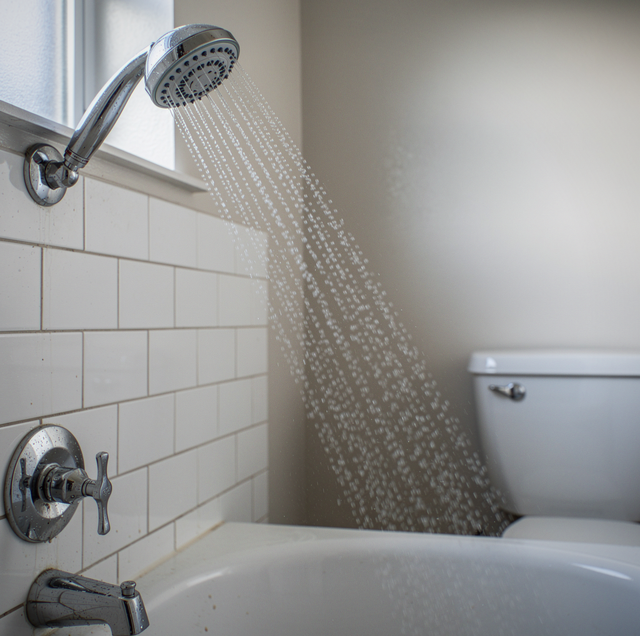
A house can pass a still-tap pressure check with flying colors and still starve a shower the moment a toilet refills. Static pressure and combined-demand flow are two different measurements: one is what a gauge reads with every fixture closed, the other is what happens when the plumbing has to carry two or three draws at once. A home that fails only the second test has plumbing that works fine in isolation and falls short exactly when it matters, at breakfast, during a shower before work, or whenever more than one person needs water at the same time.
Matching the specific symptom to where the shortfall sits narrows the search before any wall gets opened:
| Symptom | Where the shortfall likely sits |
|---|---|
| A shower that drops or turns hot when a toilet refills | A shared branch feeding both fixtures, or a shower valve that doesn't balance pressure between the hot and cold sides |
| Two showers that cannot run at once without both losing flow | A main trunk or shared branch sized for fewer fixtures than the house now carries |
| The washer or dishwasher filling slowly whenever anything else runs | A branch shared with whatever else is drawing water at the time |
| Upstairs fixtures fading at busy times of day | The main trunk, or the service line if the fade shows up even with little else running |
| Flow that has weakened gradually over several years, regardless of what else is running at the time | Pipe narrowed from the inside, a separate mechanism from shared demand |
Pressure Versus Flow Under Combined Demand
A pressure gauge threaded onto a hose bib, with everything else in the house shut off, reads static pressure, and that single number is a different diagnostic question with its own list of causes. Combined-demand flow occurs only when two or more fixtures draw at once, because that is the moment the plumbing must split a limited supply between them. Every hot-water draw also starts as cold water entering the water heater, so a hot tap opening anywhere in the house adds its flow to the cold supply line feeding the heater. A system can read a healthy static pressure and still lose ground the instant a second fixture opens, which is why a homeowner who has already ruled out low static pressure can still be facing a real shortfall. Pressure is measured in pounds per square inch and flow in gallons per minute, so the two readings answer different questions and cannot stand in for each other.
The Service Line as the First Bottleneck
Every fixture in the house draws through one buried pipe, the service line from the meter, and its failure is a separate problem with its own signs. A line too narrow for today's demand caps the flow every fixture shares before water reaches the first branch, and a line in good condition hands the question to the pipes inside the walls. The meter sits on that same path, so a restriction at either point can show at every fixture in the house, including one running by itself.
A Main Trunk and Branches Sized for Fewer Fixtures
In a trunk-and-branch layout, each branch was sized for the fixtures it served when the house was piped. A house that has since added a bathroom, a laundry sink, or an extra shower can tie those fixtures onto the nearest existing branch, because a new line back to the trunk can mean opening finished walls, and nothing about that branch grew to carry them. Water climbing to a second floor exerts pressure proportional to the height it rises, and an upstairs fixture draws on what is left.
Pipe That Has Narrowed From the Inside
A separate mechanism can compound a sharing problem or cause a shortfall on its own: older galvanized pipe rusts from within once its zinc coating is gone, and what builds up on the inner wall steadily shrinks the channel water flows through. A branch that was sized correctly when it was new can still fall short today if decades of internal corrosion have narrowed its working diameter. This kind of decline shows up as flow that has weakened gradually over years rather than a shortfall that only appears when two fixtures compete, a distinction worth keeping in mind when the symptom does not fit a shared-branch pattern.
The Shower Valve's Part in a Temperature Swing
A shower that turns briefly hot when a toilet refills is not always a branch problem. Some of that swing depends on the shower valve itself: a valve built to balance pressure between the hot and cold sides senses a drop on one side and adjusts to hold the mix steady, while an older valve without that feature lets the temperature shift whenever pressure on either side changes. A toilet's fill valve draws only cold water and stays open until the tank's float rises to shut it, so a refill drops pressure on the cold side of the shower mix for the whole fill, and an older valve lets the hot side take over the blend. A thermostatic valve responds to the same swing by sensing the water's temperature through a wax or bimetal element that moves as the mix warms, while a pressure-balancing valve senses the pressure on each side. A pressure-balancing valve holds the blend by trimming flow from the side that did not drop, so a refill can cut the shower's flow while its temperature stays steady. The same valve can carry a limit stop, an adjustable setting that caps how far the handle turns toward hot. Two houses can share the exact same branch layout and still behave differently at the shower, because one has a valve built to correct for a competing draw and the other does not.
A shower that turns scalding the instant another fixture draws water is a burn risk. Distance from the water comes first. The valve behind the trim, any pressure regulator, and any wall opening the repair needs belong to a plumber's visit.
How a Repipe Resizes the System, and What a Pressure Test Confirms
Fixing a shared-branch shortfall comes down to more capacity or fewer fixtures on the line, and a whole-house repipe is where that gets decided. Trunk and branch sizes can be increased to match the fixture count a house has today rather than the count it had decades ago, and a shower valve that lacks pressure balancing can be swapped for one that does. A whole-house repipe replaces the trunk and every branch in a single project, so the trunk is sized to match the fixture count of the branches it feeds. A repipe that moves fixtures onto individual home-run lines removes the sharing question rather than resizing it.
A pressure test before and after the work can confirm it: a gauge reading taken under combined demand, with two or more fixtures open at once, shows whether the new sizing holds flow where the old system let it drop. A leak that shows during testing is stopped at the main shutoff, since a joint that weeps under test pressure keeps releasing water until the supply is closed.
Frequently Asked Questions
No. A heater's size sets how much hot water is stored or how fast it is heated; it has no effect on how much water a shared branch can carry to two fixtures at once, and a temperature swing at a refill comes from the flow split on the way to the shower.
It can change the wash. Some dishwashers fill for a set time, so a fill that runs while another fixture draws on the same branch takes in less water than the wash cycle is built around, leaving the spray arms with less water to circulate. Models that measure the fill keep the inlet valve open until the set amount of water is in.
It can. A new bathroom's fixtures sit at the far end of whatever line feeds them, and water reaching the end of a long run has already lost pressure to friction at every length of pipe and fitting before it, so the new shower can fade the moment a kitchen or laundry tap opens.
Weak flow at a single fixture can be traced back to that fixture's aerator, cartridge, or shutoff valve. One way to tell the two apart: open a second fixture nearby and watch whether the first one's flow drops further. If it holds steady, the fault sits at that one fixture.
The test runs in two steps: a pair of fixtures fed by one branch, run together, then a pair fed by different branches, run together. If the drop shows up only when both share a branch, that branch is carrying more than it can deliver. If it shows up either way, the shortfall sits further upstream, at the trunk or the service line.
It can. Where a repipe opens the wall behind the shower, that access is the chance to swap an older valve for a pressure-balancing type, and a later swap on its own can mean opening the same wall again.
Engage whole-house repiping with water pressure testing — trunk and branch lines sized to today's fixture count, and pressure-balancing shower valve replacement. PEX Plumbing & Repiping serves Portland, Beaverton, Tigard. Call (971) 232-3079.