
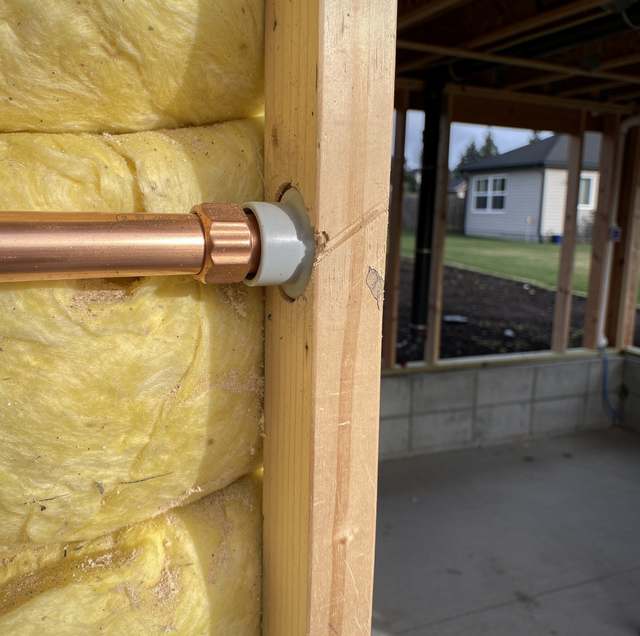
A leak shows up behind the same access panel for the third time, in almost the same spot as before, and this time the question is not how to fix it again. This is why this one section of pipe keeps failing, while the rest of the house holds pressure fine. A pipe does not leak at random. Something at that exact point is different from every other foot of pipe in the wall, and finding that difference is what separates a repair that actually holds from a fourth cut into the same drywall next year.
Water Speed and Turbulence at a Fitting
Water moving through a straight run of pipe is calm. The moment it hits a bend, a fitting, a reducer, or a valve, it speeds up and turns turbulent, the same mechanism that erodes copper pipe from the inside over time. A repeat leak at that kind of transition point is due to the fitting's shape rather than the pipe itself.
A coupling installed with a slight step where the bore narrows, a sharp elbow instead of a gradual sweep, or a solder joint that left a ridge inside the pipe all create a fixed obstruction that the flow strikes every time water runs. Swap in a new length of pipe without changing the fitting, and the same turbulence goes right back to work on the new metal.
A plumber checking this looks beyond the hole itself to what lies immediately upstream of it: the type of fitting, the angle of the turn, and whether the transition from one pipe size to another is abrupt or gradual. If the geometry is the problem, the fix is replacing that fitting with one that lets water turn or narrow more gently, not just resealing the pipe around it.
Water Hammer Pounding the Same Joint
A dishwasher solenoid, a washing machine valve, or a fast-closing fixture can stop a moving column of water almost instantly. That water has momentum, and when it has nowhere to go, the pressure spike travels back down the line until it slams into the nearest joint, fitting, or strap. You may hear it as a bang or a shudder in the wall. Structurally, it is a hammer blow to the same connection every time the valve closes.
A single hammer event does little. Years of it, closing every day, work a solder joint loose, loosen a crimped connection, or fatigue a fitting that was never designed to absorb repeated shock. The joint nearest that fast-closing valve takes the worst of it, which is why a leak tied to water hammer can reappear at the same connection even after it is resoldered or recrimped, because the valve causing the hammer is still closing the same way.
Ask what is absorbing the shock near the noisy fixture. An old, capped air chamber fills with water over time and stops cushioning anything, while a sealed arrestor fails when its internal seal wears out; either one leaves the joint, taking the hit.
What a plumber checks here is the timing: does the leaking joint sit near a fixture or appliance valve that closes abruptly, and does the noise line up with when the leak seems to get worse? Confirming that link points the fix at the valve and the shock it produces, not just the joint taking the hit.
The Pipe Rubbing Against Framing or a Strap
Pipe carrying hot water expands slightly as it heats and contracts again as it cools, cycle after cycle, for as long as the house runs hot water through it. Where that pipe passes through a drilled stud, rests across a joist, or sits inside a strap or hanger, that tiny back-and-forth movement drags the pipe wall against whatever is holding it in place. Over years, the friction wears a groove into the metal at exactly that contact point.
A strap installed too tight makes this worse by pinning the pipe against one edge instead of letting it float slightly. A hole drilled without a protective sleeve does the same thing where the pipe crosses framing. Either way, the wear occurs at a single fixed point, which is why re-soldering the same spot without loosening the strap or adding a sleeve leaves the new patch rubbing against the exact same edge.
A plumber looking for this checks the strap spacing and tension along the run, looks for a polished or thinned band on the pipe where it contacts framing, and checks whether a sleeve or grommet is missing anywhere the pipe passes through wood. Loosening a too-tight strap or adding a sleeve at that crossing is what actually stops the wear; resealing the pipe alone does not touch the cause.
A Repair That Sealed the Hole and Left the Trigger
Not every repeat leak points to a new mechanism. Sometimes the earlier repair simply fixed the hole and stopped there. A short patch soldered over a failed inch of pipe restores that inch, but if the turbulence, the hammer, or the rubbing that caused the failure is still acting on the pipe, it keeps acting on whatever metal is there now, old or new. From the outside, that looks identical to a brand-new cause, because the leak reappears in almost the same location. The difference only shows up once someone asks what was actually diagnosed the first time, rather than what was patched.
This is the case a plumber checks for by asking what the earlier repair addressed: was it just the hole, or was the trigger behind it identified and corrected at the same time? A repair record, or even a homeowner's memory of what the previous technician said, tells that story faster than reopening the wall and guessing again.
Water Chemistry and the Material's Long-Term Fit
Sometimes none of the mechanical triggers explain it, and the answer sits in the water and the ground the pipe runs through rather than in any single fitting or strap. Water that leans acidic attacks metal pipe from the inside, and corrosive soil does the same to a buried run from the outside; where both the water and the soil are mild, most materials are workable choices, and where either one is aggressive, the material has to be chosen for it.
A plumber sorting this out looks at whether the failures follow one material in a house that mixes copper, galvanized, and plastic, since a chemistry-driven cause shows a preference for whichever material handles that specific water worst, and a water test (a lab or utility report) settles the chemistry rather than guessing from the symptom alone.
When the Fix Is a Section Reroute Versus a Wider Repipe
Once the actual trigger is identified, the scope of the fix follows from it. A poorly fitting geometry, an unabsorbed water hammer spike, or one strap rubbing against a pipe are all point causes: correct that one thing, replace the affected section, and a system that is otherwise sound has no reason to fail there again. That is a section reroute, and it fits when the surrounding plumbing is a different age, a different material, or already holding up fine on its own.
The scope changes when the trigger is not local. Once a house has already had two or three leaks in different spots rather than one recurring spot, that pattern says the material and the conditions it sits in are the problem, not any single fitting. In that situation, a full repipe with a material suited to the water and soil ends the pattern instead of chasing the next spot it shows up.
A wet wall cavity can hide live wiring beside the pipe, and a saw or knife that reaches it is a shock hazard. Leave any further opening to the plumber, who shuts off water and locates wiring before cutting.
Frequently Asked Questions
Not necessarily. A compression fitting that was only finger-tightened during an earlier repair can work its way loose over time under ordinary vibration, producing what looks like a fresh failure at a joint that was never actually the wrong material or in bad condition. Checking whether a fitting is simply under-tightened is a quicker first step than assuming the pipe has failed again.
Yes, if the new ring was set out of tolerance. A copper crimp ring must be compressed within a specific diameter range to squeeze the tubing tightly against the fitting's ribs, and a plumber checks each one with a go/no-go gauge: the ring must slip into the gauge's go slot and not fit its no-go slot. A redone crimp that was never gauge-checked can look identical to a good one and still leak a second time.
A section reroute can be completed in one visit because only that portion of the system needs to be drained, opened, and repressurized. A whole-home repipe involves taking the entire house offline at once, tying in every fixture, and pressure-testing the full system before anything is closed up, which is why it is scheduled as its own project rather than treated as a larger version of a spot repair.
It can. A junction where copper meets galvanized steel, or where either meets certain other metals, can set up a small electrical reaction that corrodes the joint from the inside independent of anything the water chemistry alone would do. The standard fix at that kind of junction is a dielectric or brass transition fitting built to interrupt that reaction, not just a same-metal coupling swapped in to match what was there.
Only part of it. A softener addresses hardness, meaning the calcium and magnesium in the water, but it does not raise a low pH on its own. If the water is acidic as well as hard, softening it can leave the corrosive side of the chemistry untouched, and a pipe can keep failing from that even after softening equipment goes in.
Sometimes. If the earlier repair already located the run and left an access point, a plumber may be able to reach the strap or add a sleeve through that existing opening or a small additional cut near the same stud bay, rather than removing another full section of drywall. Whether that is possible depends on how much of the run is already exposed from the last repair.
Same spot keeps leaking? — Book a diagnostic visit that finds the actual trigger and tells you whether a section reroute or a whole-home repipe is the right call. PEX Plumbing & Repiping serves Portland, Beaverton, Tigard. Call (971) 232-3079.