
Why a Whole-Home Repipe Usually Takes Only One Day
A whole-home repipe means replacing every water supply line in the house, from the point it enters the building to every fixture it feeds. That sounds like a project that should take a week of demolition, but most crews finish a full repipe in a single working day, sometimes stretching into a second morning for cleanup and final checks. The gap between what the job sounds like and how fast it actually happens comes down to three things: the pipe material itself, how the new lines are laid out, and how a crew organizes its time inside the house.
None of this is a shortcut or a rushed job. A one-day repipe is when flexible tubing, a smarter distribution layout, and a coordinated crew replace the slow, wall-opening approach that older pipe materials once required. Understanding why it moves that fast also explains what to expect if a repipe is coming up in your own house.
Flexible Tubing Removes the Need for Demolition
The biggest reason a repipe moves quickly is the pipe material itself. Rigid copper and galvanized steel have to be cut to length and joined at nearly every turn, which means installers need direct physical access to make each connection. That access used to mean opening walls and ceilings at every bend, patching drywall, and waiting on that patch work before the job could be called finished.
Cross-linked polyethylene tubing, known as PEX, doesn't have that limitation. It's flexible enough to snake through existing wall cavities, floor joists, and attic spaces the same way electrical wire does, curving around obstacles without needing a fitting at every turn. A single continuous run of tubing can travel from a distribution point to a fixture with no joints in between, which means installers can often fish a new line through the same paths the old pipe already used, or through a nearby stud bay, without opening the wall along its full length.
Where access is needed, it's usually limited to small, strategic openings rather than long sections of exposed wall. A tech might cut a small hole near a shutoff valve or a fixture connection, feed the tubing through, and patch that single opening rather than stripping drywall along an entire run. That difference, one small access point per line instead of continuous demolition, is what turns a multi-day tear-out into a job that fits inside a single day.
A Manifold Layout Cuts the Number of Connections Way Down
The second reason has less to do with the pipe and more to do with its arrangement. Older plumbing systems were typically built as a trunk-and-branch network, where one main line splits into smaller branches, which split again into even smaller lines, with fittings at every split. Every one of those fittings is a joint that has to be cut, fit, and sealed, and every joint is also a future point where a leak can start.
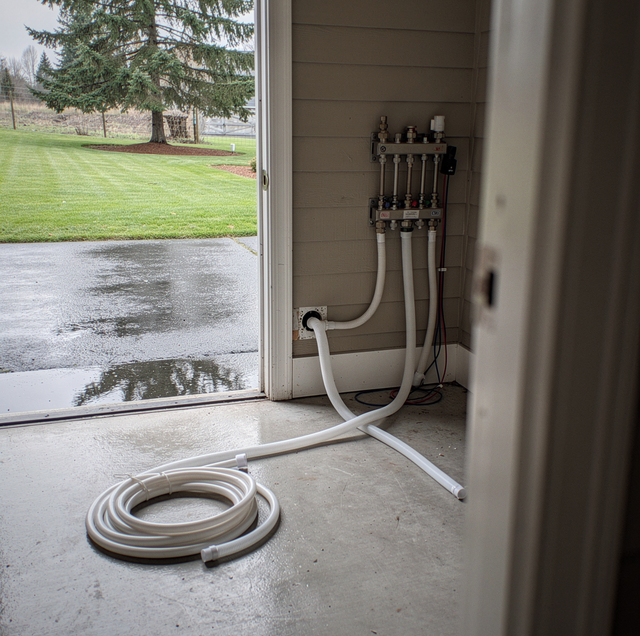
A modern repipe replaces that branching structure with a manifold, sometimes called a home-run system. Instead of branching the pipe, a central manifold houses individual valves, and a dedicated line runs straight from the manifold to each fixture, with no joints along the way. A shower gets its own line. A kitchen sink gets its own line. Each one starts at the manifold and ends at the fixture, with nothing in between to cut or solder.
This layout has two effects on the timeline. First, it collapses the number of connections a crew has to make. A trunk-and-branch system might require a joint for every branch and sub-branch; a manifold system needs a connection at the manifold and one at the fixture, and that's it for each line. Fewer connections means less time spent joining pipe and testing individual joints for leaks. Second, because each fixture has its own dedicated line back to the manifold, one fixture can be shut off and worked on without depressurizing the rest of the house, which matters more when a crew is running several trades in parallel, as described below.
Multiple Techs Working Different Zones at the Same Time
The third piece is workflow, and it's the one homeowners see least, but that shaves the most time off the schedule. A repipe crew isn't one plumber working room to room in sequence. It's typically several installers assigned to different zones of the house at the same time: one working the kitchen and a bathroom on one side of the house, another handling bedrooms and a second bathroom, another routing lines through the attic or crawlspace to feed the manifold.
Because the manifold layout means each fixture's line is independent, these zones don't interfere with each other in any real way. The tech in the kitchen isn't waiting on the tech in the attic to finish before starting a connection, and nobody has to stop because someone else needs water pressure back on to test a joint. That kind of parallel work is what compresses a job that would take one installer several days into a single day for a full crew.
Prep work happens in parallel too. While some techs are running new tubing, others may already be capping off old lines that won't be reused, setting the new manifold location, or prepping fixture connections for reconnection later in the day. By the time the last line is run, most of the surrounding work is already done, rather than starting fresh.
What a One-Day Repipe Actually Involves, Start to Finish
A typical day breaks down into a handful of distinct phases, and knowing them makes the process easier to follow if it's happening in your own house.
Water shutoff and setup: The main water supply gets shut off first, and the crew confirms the location for the new manifold, usually somewhere central and accessible, such as a utility closet or basement wall. Floor protection and dust barriers go up in work areas before anything else starts.
Old line disconnection: The old pipe is disconnected at each fixture and at the main. In most cases, old lines aren't fully torn out of the walls; they're capped off and left in place, since removing pipe embedded in a finished wall would mean exactly the kind of demolition PEX is designed to avoid. The old line simply stops being part of the working system.
New line routing: This is where the bulk of the day goes. Techs fish new tubing from the manifold to each fixture, using existing cavities and small access points as needed. Because this phase happens zone by zone with multiple people working simultaneously, it moves faster than the phase count alone would suggest.
Fixture reconnection: As each line reaches its destination, it gets connected to the fixture, whether that's a shutoff valve under a sink, a shower valve behind a wall, or a supply line behind a toilet. Reconnection typically happens as soon as a given line is finished, rather than waiting until every line in the house is done.
Pressure testing: Once all lines are connected, the system is pressurized and checked. A tech watches for drops in pressure that would indicate a loose fitting or an incomplete connection, and checks each new joint visually for any sign of a leak before water is restored to the whole house.
Cleanup and walkthrough: Access points get patched or covered, work areas get cleaned, and the crew walks through the house running fixtures to confirm everything delivers normal flow and shuts off properly.
Most of this fits inside a single working day for a typical house. Larger homes, homes with more fixtures than average, or homes where a water heater is also being swapped out at the same time may run a partial second day, usually just for patching and final checks rather than additional plumbing work.
What Can Push the Timeline Past a Single Day
A few conditions can extend a repipe beyond one day, and it's worth knowing them so expectations are set correctly before work starts. A house with an unusual number of bathrooms or a sprawling layout simply has more lines to run, which adds hours even with a full crew. Limited attic or crawlspace access can slow the routing phase if techs have to work in a tighter space than usual. And older housing stock sometimes turns up surprises once walls are opened even briefly, such as unexpected framing or pipe runs that don't match the original layout, which can add time to work around.
None of these situations are common, and none of them turn a one-day job into a week-long one. They typically add a partial second day rather than multiplying the timeline, and a good crew will flag the possibility during the initial walkthrough rather than as a surprise partway through the work.
Frequently Asked Questions
No. The speed comes from the pipe material and layout, not from skipping steps. A rushed job and a well-organized one can both finish in a day, but the difference shows up in whether every connection gets pressure tested and every line gets checked before the crew leaves, not in how many hours the work took.
Water is typically shut off for most of the day while old lines are disconnected and new ones are run. Most homeowners plan to be out of the house or make arrangements for the day, since the water supply to taps, toilets, and appliances won't be restored until reconnection and testing are complete near the end of the job.
Usually not. Old lines are disconnected and capped rather than physically pulled out of finished walls, since removing embedded pipe would require the kind of demolition that a flexible-tubing approach is specifically meant to avoid. The abandoned pipe simply stops carrying water.
Damage is generally limited to small access points near fixtures or shutoff valves rather than continuous openings along entire walls. Those access points are patched as part of the job, though the final paint touch-up is usually left to the homeowner, since color matching varies by home.
Occasionally, a wall opens to reveal framing or existing piping that doesn't match what was expected during the initial walkthrough. When that happens, a crew works around it and may need part of a second day, but it's handled as part of the same visit rather than requiring a separate appointment.
It can be, if that work is scoped in ahead of time, but it's treated as a separate task alongside the supply-line work rather than something that slows the repipe itself. Crews typically assign it to a dedicated tech so it runs in parallel with the rest of the job, rather than extending the timeline.
Ask about scheduling a one-day repipe — get a walkthrough of your home's layout and a realistic timeline before work begins. PEX Plumbing & Repiping serves Portland, Beaverton, and Tigard. Call (971) 232-3079.
