
How to Tell If Your Pipes Are Original to the House
Quick Answer: The material of your supply piping usually tells you whether it is original to the house. Galvanized steel (pre-1960s) is dull gray, has threaded fittings, and a magnet sticks to it; it rusts closed from the inside and is at or past the end of its life. Copper (1960s onward) is reddish-brown with soldered joints and lasts decades, though pre-1986 solder may contain lead. Polybutylene (roughly 1978 to 1995) is a gray or blue flexible plastic with crimped fittings and is a red flag for sudden failure. CPVC is a cream or tan rigid glued plastic. PEX is modern, flexible red, blue, or white tubing with crimp, clamp, or expansion rings. Match the home's build year to what you find on exposed runs to confirm whether the pipe is original.
When you buy or live in an older home, the plumbing inside the walls is mostly a mystery until something goes wrong. The supply lines carrying pressurized water to every fixture are the ones that matter most, because when they fail, they fail wet, and in an older house, they are often the pipes the builder installed decades ago. The good news is that you do not need to open a wall to get a strong read on what you have. The pipe material itself is a timeline. Each era of construction used a different one, and each has a look, a set of fittings, and a failure pattern you can learn to spot on the runs that are already exposed.
Why the Pipe Material Tells You the Risk
Supply piping has a service life, and that life depends heavily on what it is made of. A pipe that is original to a 1950s house has been carrying pressurized water for the better part of a century, and some of the materials used in that period were not built to last that long or have known defects that show up with age. Reading the material is a shortcut to reading the risk. Think of it like the rings on a tree: you can tell roughly when the plumbing was put in and what shape it is likely in by identifying the material and matching it against when the house was built.
The place to look is anywhere the pipe runs exposed. Basements and crawlspaces are the best spots, because the trunk lines often run bare along joists. Under kitchen and bathroom sinks, you can see the supply stubs protruding from the wall or floor. The cluster of pipes around the water heater is another good window, since hot and cold both connect there, and the material is usually visible for a few feet. Grab a flashlight and a small magnet and walk those runs before you assume anything.
Galvanized Steel: The Pre-1960s Standard
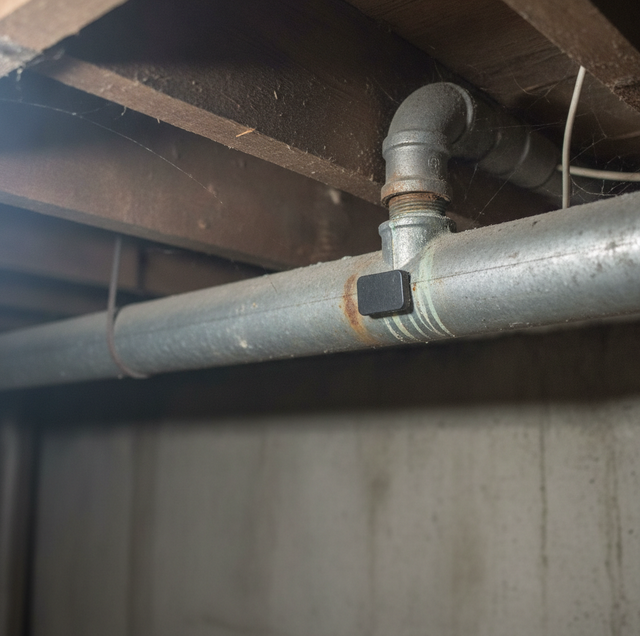
Galvanized steel was the go-to supply pipe in homes built before roughly 1960. It is dull gray, the color of an old nail, and it is heavy, rigid metal joined with threaded fittings that screw together at each connection rather than being soldered or glued. The quickest test is with a magnet: it sticks firmly to galvanized steel but not to copper or plastic. If the pipe is gray, threaded, and magnetic, you are almost certainly looking at galvanized.
The problem with galvanized is what happens inside it. The zinc coating that protects the steel wears away over the decades, and the exposed steel rusts and builds up mineral scale in a process called tuberculation. That rust narrows the bore from the inside until the pipe is choking off its own flow. The telltale signs are low water pressure that has worsened over the years, especially at fixtures farthest from the water heater, and rusty or discolored water when you first open a tap. Galvanized pipe in an older home is nearing or already past the end of its useful life, and no amount of external repair can change the corrosion occurring inside the pipe wall.
Copper: The 1960s-Onward Workhorse
Copper became the dominant supply material from the 1960s onward and is still used today. It is easy to recognize: a reddish or brown metal, often with a darker brown or greenish patina where it has aged, joined by soldered joints where a rounded, silvery bead of solder wraps around each fitting. A magnet will not stick to it. Copper is durable and routinely lasts decades, which is why finding it is generally reassuring compared with galvanized.
Copper is not without its issues. It can develop pinhole leaks, tiny perforations that corrode through the wall from the water side and show up as a green or blue-green crusty stain with a bead of moisture. And there is an age wrinkle worth knowing: solder used before 1986 could contain lead. The copper pipe itself is not the concern, but the joints on a copper system installed before then may have been sweated with lead-bearing solder. If your copper predates that period, that is a reason to test the water rather than guess.
Polybutylene: The Big Red Flag
Polybutylene is the material to identify carefully, because it is the one most likely to fail without warning. It was installed in many homes from roughly 1978 through the mid-1990s as a cheaper, easier alternative to copper. It is a flexible plastic pipe, usually gray, sometimes blue, and it is joined with crimped fittings that have a metal or plastic band clamped around each connection. If you find a gray flexible plastic pipe with crimp bands in a home from that era, take note.
The trouble with polybutylene is that it becomes brittle over time, particularly at the fittings, and can crack and fail suddenly rather than giving the slow warning that galvanized does. That unpredictability is why it carries real weight beyond the plumbing itself: home inspectors flag it, insurers ask about it, and buyers get nervous when they see it. Identifying that gray flexible pipe is the single most valuable thing this walk-through can do for you, because it turns an invisible liability into a known one you can plan around.
CPVC and PEX: The Rigid and Flexible Plastics
Two plastics fill out the modern picture. CPVC is a rigid plastic pipe, cream or tan colored, joined with glued (solvent-welded) joints, so the fittings look like they are chemically bonded rather than clamped or threaded. It shows up as an upgrade in some homes and holds up reasonably well, though it can grow brittle with age.
PEX is the flexible tubing you are most likely to see in newer work and repipes. It comes in red, blue, and white (red for hot, blue for cold, white for either), and it is connected with crimp rings, clamp bands, or expansion fittings at each joint. PEX bends around corners without elbows, which is part of why it installs quickly. Finding PEX or newer copper branching off older galvanized or polybutylene is itself a clue: it usually means part of the house was repiped or patched at some point while the original lines were left in place.
How to Date the Plumbing
Once you know the materials, you can pin down whether they are original by cross-checking a few sources. Start with the home's build year, which the county assessor's records will list; that tells you what the original builder most likely used. Then look for a plumbing permit record for a repipe, which many jurisdictions keep on file and which would show the original lines were replaced. Finally, inspect the exposed pipe and watch for mismatches: a run of new PEX or copper feeding off an older galvanized trunk means someone did partial work, and the material change marks roughly where and when.
Put those together, and the picture usually resolves. A 1952 house with dull gray magnetic pipe throughout and no repipe permit is running on its original galvanized. A 1972 house with copper and no permit is on its original copper. A 1988 house with a gray flexible pipe is very likely on its original polybutylene, which is exactly the case that warrants action.
Signs Your Original Pipes Are Failing
Material identification tells you the risk; symptoms tell you the clock is running. Watch for rusty or discolored water, especially first thing in the morning, which points to corrosion inside the galvanized pipes. Watch for water pressure that has dropped gradually over the years rather than all at once, the signature of a bore closing up with scale. Recurring pinhole leaks or slab leaks that keep appearing in new spots suggest a systemic problem rather than one unlucky fitting. Visible corrosion, flaking, or green stains at joints are the pipe telling you it is compromised. And banging or knocking in the walls, while sometimes a pressure issue, can accompany aging systems under stress. Any one of these on top of an at-risk material is a strong signal to have the system looked at.
Why Older Homes Often Need a Repipe
Older neighborhoods have a deep stock of housing built well before 1990, which is exactly the window when galvanized and later polybutylene were standard. That is why so many of these homes still have original supply lines that are at or past their reliable life. When those lines start failing, chasing individual leaks tends to be a losing game. A patch on a corroded galvanized system or a brittle polybutylene system just moves the next failure downstream to the next weak point, because the whole run shares the same age and the same defect.
That is the case for a repipe. Replacing the failing supply lines with modern material, most often PEX or copper, resets the system instead of buying a few months at a time. It ends the discolored water, restores the pressure the old corroded bore was strangling, and removes the material that inspectors and insurers flag. For an older home with original galvanized or polybutylene, a full repipe is usually the fix that actually holds.
A Note on Safety
Two cautions are worth stating plainly. First, if lead solder is a possibility because your copper or its joints predate 1986, do not try to eyeball your way to an answer. Lead is not something to guess about; a certified water test is the way to know whether it is present. Second, identifying your pipe material is a job you can safely do with a flashlight and a magnet, but cutting into pressurized lines and repiping a house is not a DIY project. Leave the actual repiping to a licensed professional who can do it without flooding the house or leaving you with a system that fails inspection.
Frequently Asked Questions
Use color, joints, and a magnet together. Galvanized steel is dull gray like an old nail, has threaded screw-together fittings, and a magnet sticks to it. Copper is reddish-brown with a rounded silvery bead of solder at each joint, and a magnet will not stick. PEX is flexible tubing in red, blue, or white with crimp rings or clamp bands at the fittings. Polybutylene is the one people confuse with PEX: it is gray or blue flexible plastic with crimp bands, so if flexible plastic looks gray rather than red or blue and predates the mid-1990s, treat it as polybutylene until proven otherwise.
Because it fails in a way you cannot see coming. Over time, the plastic, and especially the fittings, become brittle, and the pipe can crack and let go suddenly rather than weeping slowly, as corroded metal does. The failure point is very often at the fitting connections rather than mid-run. Beyond the plumbing risk, it carries a paper trail of trouble: many insurers ask about it, and some decline to cover homes that still have it, and buyers routinely flag it during inspection. Finding and confirming that the gray flexible pipe is the tell that lets you deal with it before it deals with you.
The copper pipe itself does not; it is a safe material. The concern is the solder used at the joints. Before 1986, plumbing solder commonly contained lead, so a copper system sweated together before that date may have lead in the joints that can leach into standing water. This is not a reason to panic, and it does not condemn the pipe, but a home with pre-1986 copper is worth a water test to confirm what is actually coming out of the tap, particularly if there are young children in the house.
Three sources triangulate it. The county assessor's record lists the build year, which indicates the original material. A plumbing permit record, which many jurisdictions archive and make searchable, will show a repipe if one was pulled and permitted. And the pipe itself gives it away when you spot mismatches: a stretch of newer PEX or copper branching off an older galvanized or polybutylene trunk means part of the house was replaced while the rest was left original, and the transition point marks where the work stopped.
You can patch, but on galvanized or polybutylene, it tends to be a short-term move. Both materials fail because of a condition they share: corrosion scale in galvanized and brittleness in polybutylene, so fixing one spot shifts the next failure downstream to the next weak point of the same age. A spot repair on a copper pinhole from a one-off cause can hold, but when the material itself is at the end of life, a full repipe to PEX or copper is usually the lasting fix rather than a rolling series of patches.
Both are solid, and the right choice depends on the house. PEX is flexible, so it runs around corners with far fewer joints, installs quickly, and tolerates freezing better because it can expand slightly rather than split outright. Copper is rigid and long-proven, withstands heat, and some homeowners simply prefer a metal system. Layout matters too: tight or complex routing often favors PEX, while some situations suit copper. A repipe professional can walk through your specific home and point you to the material that fits its layout and your preference.
Book a repipe assessment — know exactly what pipe is in your walls and whether it is time to replace it. PEX Plumbing & Repiping serves Portland, Beaverton, and Tigard. Call (971) 232-3079.
