
Why Is My Water Pressure Low Throughout the House?
A single dribbling faucet is usually a clogged aerator. But when the shower, the kitchen sink, and the hose bib all run weak at once, the trouble sits somewhere before the water reaches those fixtures. Whole-house low pressure has its own short list of causes, and working through them in the right order saves you from replacing parts that were never the problem.
Some of these causes take five minutes and a wrench to rule out. One of them, especially in an older home, points at the pipes themselves. Here is how to check the easy things first and know when you have crossed into pipe territory.
Start at the Front of the System
If the weak flow hits every fixture, the restriction has to be upstream of where your plumbing branches off to individual taps. That means the main line, the meter, the pressure regulator, or the supply pipes that feed the whole house. A single slow faucet is a local issue; weak everything is a system issue. So the diagnosis moves from the front door inward, cheapest and easiest checks first.
1. Check the Shutoff and Meter Valves
The most common quick fix costs nothing. The main shutoff valve, where water enters the house, and the valve at the water meter, can be left partly closed after plumbing or utility work. A gate valve that looks open can be a couple of turns short, which is enough to choke the whole house. Trace the line from the meter to the house, find both valves, and make sure each is opened all the way. If pressure jumps back the moment you do, you are done.
2. Test the Pressure Regulator
Many homes have a pressure-reducing valve, or PRV, a bell-shaped brass fitting usually sitting just past the main shutoff. It knocks street pressure down to a safe level for household plumbing. When a PRV fails, it often fails low, dropping pressure everywhere at once. You can check it with a screw-on gauge at any hose bib: turn off everything indoors, thread the gauge on, and open the bib. Normal household static pressure reads roughly 45 to 80 psi. A reading well under that, with valves confirmed open, points at the regulator. A PRV is a defined, replaceable part, so this is a repair, not a rebuild of your plumbing.
3. Rule Out a Hidden Leak
A large leak in the main or a buried supply line bleeds off pressure before it ever reaches your taps. To check, shut off every fixture and appliance in the house, then look at the water meter. If the dial or the small flow indicator is still creeping, water is moving somewhere it should not be. A leak like that weakens the pressure while quietly running up the bill and soaking whatever is nearby, so it is worth chasing down whether it is your pressure culprit.
4. Suspect the Pipes
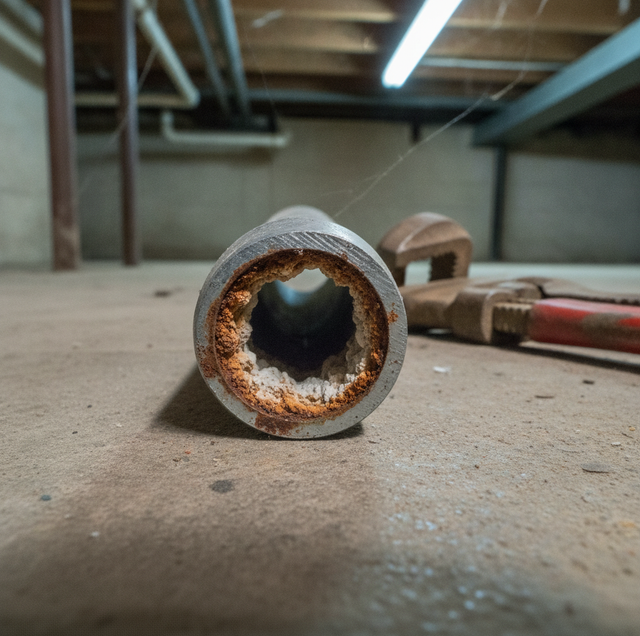
When the valves are open, the regulator tests fine, and the meter sits still, the restriction is inside the pipes. In older homes, this is the usual answer. Galvanized steel corrodes from the inside out: over decades, rust and mineral scale coat the interior walls in a bumpy layer called tuberculation, steadily shrinking the channel water flows through. The pipe looks fine from the outside, while its opening has closed to a fraction of the original bore. No valve adjustment and no cleaning fixes that, because the bottleneck is built into the pipe wall itself.
Why Old Pipe Cannot Be Cleaned Back Open
Tuberculation is not a film you can flush away. It is corrosion-bonded to the steel, and scraping or chemically stripping it would eat away at what remains of the pipe. Once galvanized lines have narrowed, that diameter is gone for good and continues to close as corrosion advances. This is why pushing harder rarely helps. Adding a booster pump to a corroded pipe forces more pressure through a restricted channel and stresses aging joints without touching the actual bottleneck, a poor trade on a pipe already near the end of its life.
The lasting fix is a repipe: replacing the old galvanized or polybutylene lines with new pipe that carries full-diameter flow and does not corrode the way steel does. A whole-house PEX repipe restores pressure at the source rather than fighting the pipe, and flexible tubing tolerates occasional hard freezes far better than brittle old metal. It is a larger job than swapping a regulator, but it is the one that solves the problem when the pipe is the cause.
Older Homes and Aging Pipe
Plenty of homes plumbed before the 1970s used galvanized steel, and certain later decades used polybutylene, both of which have well-known failure patterns. Galvanized narrows and corrodes; polybutylene grows brittle and prone to failure at its fittings. Decades on, that aging pipe is now at the point where the interior narrowing shows up as pressure that has quietly faded year after year. If you have discolored water at first draw, recurring pinhole leaks, or flow that keeps dropping in a home of that vintage, the pipe material is telling you it has reached the end of its service life, which is exactly when a repipe restores both the pressure and the reliability.
Frequently Asked Questions
Not quite, and the difference matters for diagnosis. Pressure is the static force in the line, measured with a gauge when nothing is running; flow is how much water actually moves when you open a tap. A corroded, narrowed pipe can leave your static pressure reading close to normal while the flow at the fixture is weak, because the restriction only shows up once water is moving. That is why a plumber checks both static and flowing pressure: weak flow with healthy static pressure points straight to a pipe restriction rather than to a regulator or a valve.
It can. Municipal supply pressure varies by neighborhood and elevation, and it can sag during peak morning and evening demand when everyone is using water at once. If your pressure drops at predictable times of day and your own valves, regulator, and pipes check out, it is worth asking the utility what pressure they deliver to your meter. Truly low supply pressure from the street is the one situation where a booster pump is the right tool, unlike low pressure from a corroded pipe, where a booster only strains the failing line.
Often, yes, and skipping it causes its own problems. A regulator creates a closed system, meaning water cannot flow back out to the street. When your water heater warms that trapped water, it expands with nowhere to go, so the pressure spikes and repeatedly stresses the heater's temperature-and-pressure relief valve, sometimes making it weep. A small thermal expansion tank gives that expanding water a cushion to push into, protecting the heater and keeping pressure steady. If you have a PRV but no expansion tank, that is worth raising with a plumber.
Yes, and this one is easy to miss. A whole-house sediment filter with a clogged cartridge, or a softener with fouled or channeled resin, sits in the main line and throttles every fixture downstream when it gets dirty. If your pressure faded after you installed treatment equipment, or has slowly worsened since the last cartridge change, try replacing the filter cartridge and putting the softener on bypass to test. A restriction there mimics a whole-house pressure problem while being a far simpler fix than a repipe.
Follow the incoming line from the water meter to the main shutoff, then check the meter valve out at the street box. A round wheel handle should turn freely to a full stop when open; a lever-style ball valve should sit fully in line with the pipe, not at an angle. If a handle stops partway or a lever sits crossways to the pipe, it is throttling flow. Open each one all the way and retest the faucet before assuming a deeper problem, since this is the one cause you can fix for free.
Low pressure on the hot side alone usually is not a whole-house pipe problem, and the distinction saves a lot of guessing. When only hot water is weak, the restriction is typically at the water heater, clogged heat-trap nipples on the hot outlet, sediment in the tank, or corroded fittings right at the heater, rather than in the home's supply lines. If both hot and cold are weak everywhere, that points back to the valves, regulator, or the pipes themselves, which is the whole-house picture a repipe addresses.
Working Through the Causes in Order
Whole-house low pressure is a system problem, so the answer lives upstream of your fixtures, and the smart move is to work the list from cheapest to costliest: open the valves, gauge the regulator, watch the meter for a leak, and only then look hard at the pipe. When the first three check out, and the pressure has been fading for years in a home with aging galvanized or polybutylene lines, the plumbing itself is the restriction, and a repipe is what brings back full flow for good.
If your whole-house water pressure has faded and old pipes are the likely cause, we can test your system and restore full flow with a PEX repipe. PEX Plumbing & Repiping serves Portland, Beaverton, and Tigard. Call (971) 232-3079.
