
Signs of a Hidden Pipe Leak: 10 Clues Before You See Water
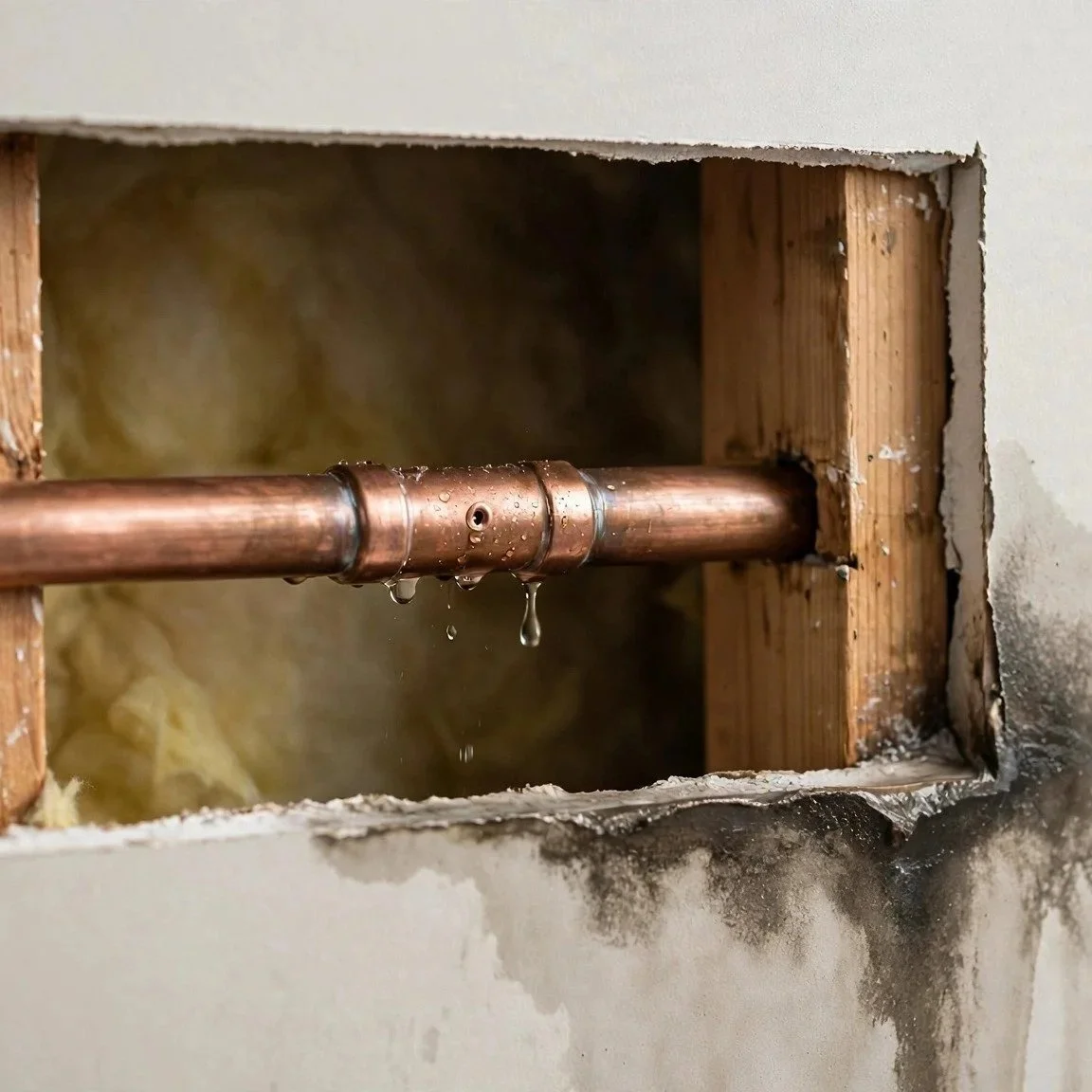
A pipe that fails inside a wall, above a ceiling, under a concrete slab, or below the yard rarely announces itself with a puddle. The water has somewhere else to go first: into framing, into insulation, into soil, into the gaps between building materials. By the time a stain finally shows on a surface you can see, the leak has often been running for weeks. That is why hidden leaks are usually caught by their side effects rather than the water itself.
The good news is that those side effects are readable. A pressurized pipe losing water behaves in consistent ways, and once you know what those ways look like, sound like, and cost, you can catch a leak early enough to keep the repair small.
Quick Answer: The most reliable early signs of a hidden pipe leak are an unexplained jump in the water bill, a water meter that keeps moving after everything is shut off, the sound of running water when no fixture is on, and damp or discolored spots on walls, ceilings, or floors. Warm patches on a floor, a musty smell, and lush wet areas in the yard point to specific leak locations. A licensed plumber can pinpoint the source without opening every wall.
Why a Hidden Leak Hides in the First Place
Your supply lines are always under pressure, typically somewhere between 40 and 80 psi in a residential system. That pressure is what makes a hidden leak both destructive and detectable. Even a pinhole pushes water out continuously, day and night, whether or not anyone is using a faucet. A leak the width of a pencil tip can release hundreds of gallons over a month without a single drop reaching a visible surface.
Think of your plumbing like the circulatory system behind a wall of skin. A small internal bleed does not show up as blood on the outside. It shows up as swelling, bruising, and pressure changes, warning signs that something under the surface is wrong. Hidden pipe leaks work the same way: the clues surface indirectly, in the materials and readings around the pipe, well before water breaks through.
The Signs, From Cheapest Clue to Costliest Damage
The water bill jumps for no reason: A sudden, unexplained increase in your bill is often the clearest signal. If your household routine has not changed, but your usage has climbed, water is going somewhere you are not using it. Compare a few recent bills; a steady creep upward, or one sharp spike, is worth investigating rather than dismissing.
The meter keeps moving when everything is off: Your water meter measures every gallon that enters the house. If it registers flow while no water is running, that flow is a leak. This is the backbone of at-home leak detection and costs nothing but a few minutes of your attention.
You hear water with nothing turned on: A faint hiss, trickle, or rushing sound inside a wall or under the floor, with every fixture off, is escaping water. Pressurized leaks make noise as water forces through a small opening. Quiet the house, put an ear near suspect walls, and listen.
A warm patch on the floor: A section of floor that feels warm underfoot, especially on tile or slab, can mean a hot-water line is leaking beneath the concrete. The escaping hot water heats the material above it. This is one of the more specific clues because it points not just to a leak but to which line failed.
Stains, bubbling paint, or sagging surfaces: Damp or discolored spots on drywall, brown rings on a ceiling, paint that bubbles or peels, and a soft or sagging patch overhead all indicate water collecting behind a surface. Drywall wicks moisture and darkens; a growing stain means an active source rather than an old, dried event.
A musty smell or visible mold: Persistent moisture invites mold and mildew, and both carry a distinct earthy, musty odor. If a room, cabinet, or corner smells damp no matter how much you clean, the smell is often coming from wet material feeding on a leak you cannot see.
Higher indoor humidity: A leak steadily adds moisture to the air. If one area of the home feels clammy, windows fog more than they used to, or a hygrometer reads higher than the rest of the house, evaporating leak water may be the source.
A drop in water pressure: When water escapes before it reaches your fixtures, the pressure at the tap can fall. A general, unexplained decline in flow, particularly if it worsens over time, can accompany a supply-side leak.
Lush or soggy patches in the yard: For underground service and irrigation lines, the ground tells the story. An unusually green, fast-growing, or perpetually wet patch of lawn, especially during a dry stretch, often sits directly above a buried leak feeding that soil.
Foundation cracks, settling, or shifting: Water escaping under or beside a foundation erodes and softens the soil that supports it. Over time, that can show up as new cracks, uneven floors, sticking doors, or visible settling. These are the costliest signs because they mean the leak has been working long enough to affect the structure.
Why It Is Worth Catching Early
A hidden leak is not only a water-waste problem. Water trapped in framing rots wood, corrodes fasteners and connectors, and saturates insulation so it stops insulating. It creates the constant dampness that mold needs to spread through wall cavities. Underground, it undermines the compacted soil on which a foundation depends. None of this is dramatic on any single day, which is exactly the danger: the damage compounds quietly while the house looks fine from the hallway.
Sorting Out What You Are Actually Seeing
Not every damp spot is a pressurized pipe failure, and telling the types apart saves time and money. A supply-line leak is constant because the pipe is always pressurized, so it tends to show steady dampness and a moving meter regardless of what anyone is doing. A drain-line leak behaves differently: the pipe only carries water when a fixture drains, so the wetness appears in bursts tied to sink, tub, or laundry use. And some suspected leaks are not leaks at all. In humid conditions, cold supply pipes and air-conditioning ducts can sweat and drip condensation that mimics a leak. Reading the timing and the conditions helps separate the three.
The age and material of your pipes shape how likely a hidden leak is in the first place. Galvanized steel corrodes from the inside and thins with age. Polybutylene, common in some older homes, is prone to failure. Even copper, durable as it is, can develop pinhole leaks after decades of service. Homes with older plumbing carry more risk, and often the smart fix is not one spot but a plan for the whole system.
The At-Home Meter Test, Step by Step
You can confirm a leak yourself before calling anyone:
- Turn off every faucet, appliance, and water-using device in the house, including the ice maker and any irrigation timer.
- Find your water meter and note the exact reading or the position of the low-flow indicator.
- Wait without using any water, then check the meter again.
- If the reading moved or the indicator spun, water is flowing somewhere it should not be.
This test tells you a leak exists on the pressurized side. It does not tell you where, and that is where professional tools take over.
How Professionals Pinpoint It Without Demolition
The fear that finding a leak means tearing open every wall is outdated. Modern leak detection is designed to open only the spot that needs opening. Plumbers use acoustic listening equipment sensitive enough to hear water escaping inside a wall or under a slab. Thermal imaging cameras read the temperature differences a leak creates, so a hidden hot-water line or a cool, damp patch shows up as a clear signature. Pressure testing isolates individual lines to identify which one is losing pressure. Used together, these methods narrow a vague symptom down to a specific location, so the repair is targeted rather than exploratory.
Once the source is known, the fix follows the location and the condition of the system. A single isolated failure in otherwise sound plumbing may need only a spot repair. A pipe running through an awkward or repeatedly failing path may be better rerouted. And when the leak is one symptom of aging, a deteriorating pipe throughout the house, a full repipe replaces the recurring problem instead of chasing it leak by leak.
A Note on Safety
Treat standing water near any outlet, appliance, or electrical panel as a hazard first and a plumbing problem second: keep clear and cut power to the area at the breaker if you can do so safely before mopping up. Do not disturb visible mold growth, which can release spores when handled. And because pressurized leaks inside walls and slabs are hard to locate accurately and easy to misdiagnose, professional leak detection is the safe path once the meter test confirms something is wrong.
Frequently Asked Questions
Shut off every faucet and water-using appliance, then watch the water meter for 15 to 30 minutes. If the meter keeps creeping upward even when nothing is running, the house is leaking somewhere on the pressurized side. This is the simplest at-home confirmation you can do without any tools, and a still meter over that window is reassuring evidence that the supply side is holding.
A warm patch underfoot usually points to a hot-water line leaking under a slab. The escaping hot water heats the concrete and the flooring above it, and that warm area, sometimes paired with slightly higher humidity nearby, is a classic slab-leak clue. Because it identifies a hot line specifically, it can help a plumber decide where to focus before any equipment comes out.
Each tool has conditions it favors. Acoustic listening works best on rigid, pressurized pipe, where the escaping water makes a clear, carrying sound. Thermal imaging needs a temperature difference to read, so a hot-water leak shows up far more easily than a cold one. That is why a tech may deliberately run hot water through the suspect line to warm the leak and help the camera pinpoint it. Pressure testing then isolates which line is losing water, so together the three narrow the search to one spot to open.
Two clues separate them fast: the meter and the smell. A supply leak moves the water meter because the line is always pressurized, and the water itself usually smells of nothing. A drain leak generally does not move the meter, since the pipe only carries water when a fixture empties, and it can smell of sewage or greywater from what went down the drain. Reading the meter and the odor together point to which side of the plumbing has failed.
It can be, and there is a simple test. Wipe the pipe or surface completely dry and watch it for a day. Condensation only comes back when the air is humid, or the AC is running, so it clears and returns with the conditions. A real leak keeps re-wetting the same spot, no matter what the air is doing. The pattern over that day, tied or not tied to humidity, is what tells the two apart before anyone opens a wall.
Each material fails in its own place, which tells a plumber where to look first. Copper pinholes tend to cluster on the hot lines and at high-velocity elbows, where flow is fastest. Polybutylene usually fails at its plastic acetal fittings rather than along the tube itself. Galvanized steel corrodes worst at its threaded joints, where the wall was cut thinnest. So the material in a home points straight at the likeliest failure spot before any wall comes open.
Book professional leak detection today — pinpoint the source before it costs you framing, flooring, or foundation. PEX Plumbing & Repiping serves Portland, Beaverton, and Tigard. Call (971) 232-3079.
