
PEX Manifold Plumbing: The Breaker-Panel Setup for Water
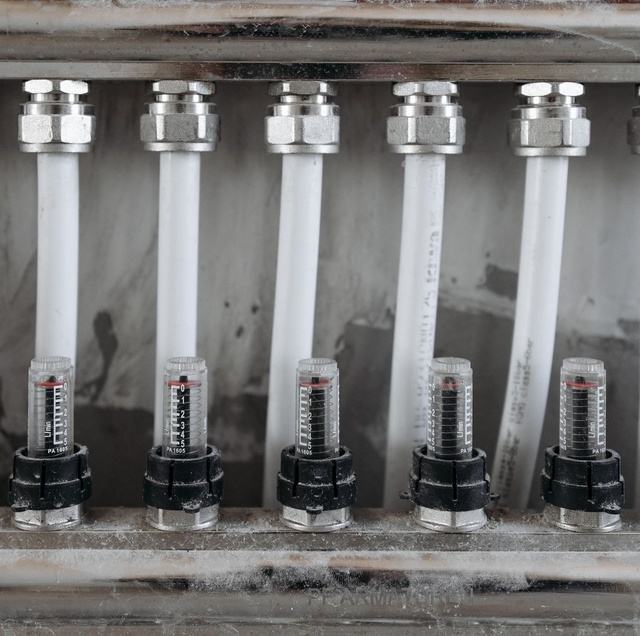
Quick Answer: A PEX manifold (home-run) system runs a separate flexible PEX line from a central manifold to every fixture in the house. The manifold works like a breaker panel for water: hot and cold supplies enter it, and each outgoing line has its own shutoff. One tub, one sink, one toilet, one line each. That means steadier pressure when several fixtures run at once and the ability to isolate any single fixture without shutting off the whole house.
Turn on the shower while someone starts the dishwasher, and in many houses the water at one fixture drops to a trickle. That fight over a shared supply line is the problem a PEX manifold system is built to end. Instead of a few large pipes feeding everything, this layout gives each fixture its own dedicated line back to one central point.
What A Manifold Actually Is
A manifold is a metal or engineered-polymer block with one inlet and several outlets. Water comes in through the main supply, and the block splits it into individual ports. A repipe uses two of them: a cold manifold fed by the incoming cold line, and a hot manifold fed by the water heater. Each port on the block feeds one PEX line, and each port carries its own small shutoff valve.
The breaker-panel comparison is close to exact. In an electrical panel, one main feed comes in and each circuit branches off with its own breaker you can flip independently. A plumbing manifold does the same with water: one feed in, many labeled lines out, each with its own valve. Stand at the manifold, and you can read where every line goes and cut water to any one of them by hand.
Because every fixture traces back to this single point, the layout is called "home-run." Each line makes an uninterrupted run from the manifold to the fixture with no branches or hidden tees along the way.
How The Older Trunk-And-Branch Layout Compares
The plumbing in most older homes uses trunk-and-branch. A large main pipe, the trunk, runs through the house. Smaller branch lines tee off it to reach each room or fixture. Several fixtures share the same branch, and the branch shares the trunk with everything else.
That design uses less pipe, which is why it became standard. The cost is shared capacity. When two fixtures on the same branch draw water together, they split the flow, and the one with less demand loses out. You feel it as the pressure drop when the washing machine fills mid-shower.
Trunk-and-branch also relies on tee fittings buried inside walls and ceilings to make each split. Every one of those joints is a connection that lives out of sight, and every connection is a spot that can eventually weep or fail where you cannot see it.
The manifold difference in one line: A home-run system trades shared pipes and hidden tees for many dedicated lines and one accessible control point.
Why Homeowners Choose A Manifold
Each fixture has its own line and its own shutoff. If a bathroom faucet needs a cartridge swap, you close that one valve at the manifold and the rest of the house keeps running. No hunting for a stop valve behind a vanity, no shutting the whole home down for one repair.
Pressure stays steadier under simultaneous demand. Since fixtures do not share a branch, one running fixture has far less effect on another. Two showers, or a shower and a dishwasher, hold their flow better because each is pulling through its own dedicated path rather than competing on a common line.
Hot water can reach some fixtures faster. A dedicated line lets you run a smaller-diameter tube to a low-flow fixture like a bathroom sink. Less water sits in a narrow line, so less has to be pushed out before hot water arrives. The volume of cooled water waiting in the pipe is what you wait through at the tap, and a right-sized home-run line shrinks it.
Fewer connections hide inside walls. Each home-run line travels from the manifold to the fixture as one continuous length. With the splits consolidated at the accessible manifold instead of scattered through the structure, there are fewer in-wall joints, and fewer joints means fewer potential leak points where you would never spot the drip until damage was done.
The Tradeoffs Worth Knowing
A manifold is not automatically the right answer for every home. It uses noticeably more tubing than trunk-and-branch, since every fixture gets a full run back to one point instead of tapping a nearby branch. More tubing and more individual terminations mean more labor to install, which is the main reason the material and time investment runs higher than a like-for-like branched repipe.
The system also needs a sensible central location for the manifold: a spot in a garage, basement, utility closet, or mechanical wall that is reachable and roughly central so line lengths stay reasonable. Homes with an awkward footprint or no good central cavity can make a pure home-run harder to route cleanly.
That is why many repipes land on a hybrid. A hybrid runs manifold-style home-run lines to the fixtures that benefit most, such as primary baths and the kitchen, while a short sub-trunk feeds a cluster of nearby low-priority fixtures. You keep the individual shutoffs and pressure gains where they matter and trim the tubing and labor where they do not.
PEX-A Versus PEX-B, And How Lines Connect
Manifold systems are built with PEX, and the tubing comes in grades. PEX-A and PEX-B are the two you will hear about most. Both are cross-linked polyethylene, and both carry potable water; the difference is how they are made and how they join.
PEX-A is the most flexible grade and is joined with an expansion fitting. The installer uses a tool to expand the tube end, and the reinforcing ring slips into the fitting, and the tube shrinks back and grips it. That method leaves the fitting close to full bore inside, so it restricts flow less at each joint. PEX-A also tolerates tight bends and can recover from a kink using applied heat.
PEX-B is a bit stiffer and is joined with a crimp ring or a stainless clamp ring squeezed over the tube and fitting. The fittings are usually insert-style, which sit inside the tube and narrow the passage slightly more than an expansion joint. PEX-B is common, well proven, and installs with tooling many plumbers already carry.
For a manifold repipe, the practical takeaway is that either grade works, and a good installer sizes the tubing and picks the joining method to suit the tool set and the runs. What matters far more than the letter is that every connection is made correctly, because a bad crimp or a poorly seated expansion joint can leak inside a wall.
Where A Manifold Shines In A Repipe
A repipe already means opening walls and pulling out the old distribution system, so the incremental effort of routing home-run lines to a central block is smaller than adding a manifold to plumbing that is otherwise staying put. If the walls are open anyway, it is the natural moment to gain the individual shutoffs and the cleaner pressure behavior.
The payoff is largest in a home with multiple full baths, a household that runs several fixtures at once, or an owner who wants to isolate a fixture for service without disrupting the rest of the house. Replacing failing galvanized or polybutylene supply lines is exactly the scenario where a manifold earns its place, because you are rebuilding the distribution from scratch and can lay it out for how the home is actually used.
A repipe of this kind is skilled work, not a weekend project. Walls get opened and closed, each joint has to be made and tested correctly, and the tie-ins to the water heater and main have to be right. PEX should not be left exposed to prolonged sunlight, since UV degrades it over time, and it should never connect straight to a water heater without the required metal or transition nipple that handles the heat at the tank. Local code governs materials, support spacing, and those transitions, and the rules vary from place to place, so the layout should be verified against what applies where you live.
Frequently Asked Questions
Rarely in a clean way. A true home-run needs a dedicated line pulled to every fixture, which means access to each run, so it almost always coincides with opening walls during a repipe. What is more feasible on existing plumbing is a "mini-manifold" that serves one remodeled bathroom or a kitchen off a single feed, giving that zone its own local shutoffs without re-plumbing the whole house.
Home-run lines are commonly 3/8-inch or 1/2-inch depending on the fixture's demand, while the trunk feeds and higher-flow fixtures like tubs use 1/2-inch or 3/4-inch. The point of a manifold is right-sizing: a bathroom sink can take a smaller line than a shower, which reduces the standing water you wait through before hot arrives at that low-flow tap.
Very little, but the shutoff valves benefit from being exercised. Turning each valve fully closed and open once or twice a year keeps it from seizing, so it actually works the day you need to isolate a fixture. Label the ports too; a manifold whose lines are unmarked loses much of its at-a-glance advantage during an emergency.
No. They come in brass, in engineered polymer like PPSU, and in copper configurations. Polymer manifolds resist the mineral scaling and corrosion that can build up in metal over years of hard water, while brass offers a very rigid mounting body. The choice often follows local water chemistry rather than a universal best pick.
It does not raise the pressure your utility or well delivers; that is set upstream. What it improves is pressure stability, meaning how well a fixture holds its flow while others run. By removing the shared-branch competition of trunk-and-branch, each fixture keeps closer to its full available flow during simultaneous use rather than dropping when a neighbor opens up.
They can, but they need insulation and proper support, since PEX carries no freeze protection on its own and an unheated run can freeze in a cold snap. Installers also secure the tubing at the spacing the manufacturer and local code require so it does not sag or chafe, and they keep it clear of any recessed light housing or flue that gets hot.
Ask us whether a home-run manifold fits your house — cleaner pressure and a shutoff for every fixture, planned around how you live. PEX Plumbing & Repiping serves Portland, Beaverton, and Tigard. Call (971) 232-3079.
