
Trenchless vs. Traditional Water Line Replacement
When a Water Line Actually Needs Replacing
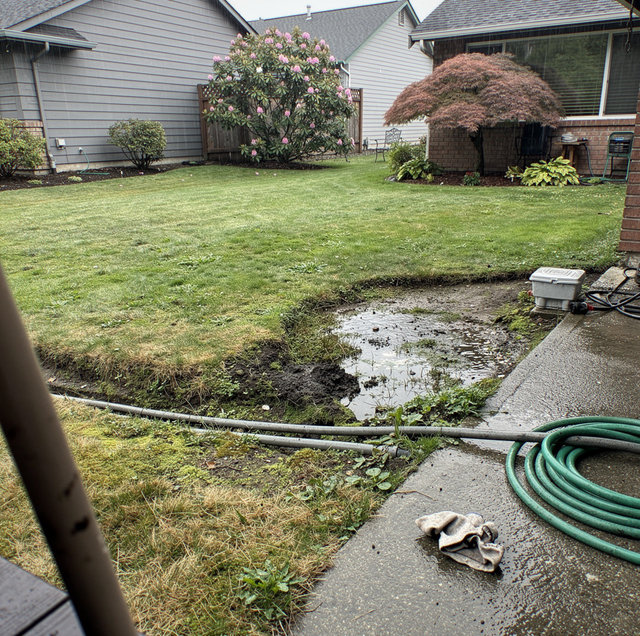
A failing water line rarely announces itself with a single dramatic event. More often you notice a string of small clues: water pressure that has dropped for no clear reason, a wet patch in the yard that never dries out, a spike on your water bill, or discolored water when you run an outside spigot. Galvanized steel and polybutylene lines are the two materials most likely to cause this kind of slow failure, since both corrode or degrade from the inside over the decades.
Once a line is confirmed to be failing, the next decision is not whether to replace it, but how. You generally have two paths: traditional excavation, where a trench is dug along the pipe's route, and the old line is physically removed, or trenchless replacement, where a new line is pulled or burst into place through the existing corridor with only small access points dug at each end. Both get you a new water line. They get you there in very different ways, with different costs to your property and different limits on when they can be used.
This guide walks through how each method works, when one makes more sense than the other, and the questions to ask before you commit to either.
How Traditional Excavation Works
Traditional replacement is the method plumbers have used for generations, and it's still the right call in many situations. A trench is dug from the water meter or curb stop to the point where the line enters your home, following the same general path as the existing pipe (or a new path if the old one runs in an inconvenient location). The old pipe is removed, a new line is laid in the trench, connections are made at both ends, and the trench is backfilled and compacted.
The main advantage of this approach is flexibility. Because the crew has full physical access to the pipe's entire length, they can change direction, relocate the line, adjust the depth, or work around obstacles they discover mid-dig. If the existing pipe route is poor, this is your chance to fix it. It's also often the more practical option when the old pipe has already collapsed or has sections crushed flat, since there is no intact pathway for a trenchless method to use.
The tradeoff is disruption. Digging a trench across a lawn, garden bed, or section of driveway means the ground has to be restored afterward, and that restoration takes time even after the plumbing work is finished. Established landscaping, hardscape, irrigation lines, and mature root systems in the trench path may need to be cut through or worked around, and some of that damage isn't fully reversible in the short term.
How Trenchless Replacement Works
Trenchless replacement encompasses a couple of related techniques, but the two most commonly used for water lines are pipe bursting and pipe lining.
Pipe bursting uses a bursting head that is pulled through the old pipe from one access pit to another. As the head travels through, it fractures the old pipe outward into the surrounding soil while simultaneously pulling a new pipe in behind it. The result is a full-diameter (often larger-diameter) replacement line installed along the same path as the old one, without a continuous trench.
Pipe lining works differently: instead of bursting the old pipe, a flexible liner coated with resin is inserted into the existing pipe and then cured in place, forming a new pipe within the old one. Lining is used more often on drain and sewer lines than on pressurized water supply lines, since it slightly reduces the interior diameter and relies on the host pipe to hold its shape during installation.
For a water service line, pipe bursting is typically the trenchless method used, since it installs a new pipe rather than coating an existing one. Both trenchless methods require small access pits at each end of the run, so trenchless doesn't mean no digging at all. It means the ground in between those two points stays undisturbed.
Trenchless replacement has real limits. It follows the existing pipe's path, so it won't help if the pipe needs to be rerouted. It generally needs a continuous, intact corridor to pull through, so pipes that have already collapsed, crushed, or split apart in multiple places can be difficult or impossible to burst cleanly. Soil with a lot of large rock or existing utilities crowded close to the water line can also limit how well the technique performs.
Comparing the Two Methods
| Factor | Traditional Excavation | Trenchless Replacement |
|---|---|---|
| Landscaping and hardscape disruption | Trench dug along full pipe run; lawn, beds, and driveway sections along the path are disturbed | Two small access pits only; ground between them stays intact |
| Restoration work after the job | Backfill, soil compaction, and replanting or repaving often needed | Minimal patching at the two access points |
| Typical project timeline | Can take longer overall once digging, backfill, and restoration are counted | Often faster start-to-finish since there is no long trench to fill and restore |
| Ability to reroute the line | Full flexibility to move or redirect the pipe | Locked to the existing pipe path |
| Works with a collapsed or crushed pipe | Yes, old pipe is fully removed regardless of condition | Difficult or unreliable if the old pipe has collapsed or split badly |
| Soil and obstruction sensitivity | Rocky soil and nearby utilities slow the dig but do not block it | Dense rock or utilities crowding the pipe path can limit or rule out the technique |
| Access to inspect surrounding conditions | Full visual access to the pipe, soil, and nearby lines during the dig | Limited to what the two access pits reveal |
| Effect on mature trees or root systems | Roots in the trench path may need to be cut | Root interference is usually confined to the two access points |
| Best fit | Pipe needs to move, ground is already being opened for other work, or the old pipe is badly failed | Pipe path is sound, landscaping or paving above it is worth protecting, and access points can reach both ends |
Choosing Between Them: What Actually Drives the Decision
Pipe condition is the first filter. A line that has partially collapsed, has multiple crushed sections, or has failed at more than one point along its run is a poor candidate for bursting, because the technique depends on pulling a bursting head through a continuous corridor. In that scenario, traditional excavation is often the more reliable route, even if it entails greater disruption.
Soil and site conditions matter next. Bursting performs best in soil that yields cleanly around the fracturing pipe. Heavy clay, dense rock, or a water line running close to other buried utilities can make trenchless work harder to execute safely, and a plumber may recommend traditional digging simply because the ground itself makes a trenchless approach difficult.
What sits above the pipe is often the deciding factor for homeowners. If the line runs under a driveway, a paved walkway, mature landscaping, or a section of yard you've invested time and money in, trenchless replacement protects nearly all of it from disturbance, since only the two access points are opened. If the pipe runs under an area that is already bare dirt, due for renovation, or easy to restore, the disruption argument carries less weight and traditional excavation becomes a reasonable, sometimes simpler choice.
Rerouting needs to settle the question outright in some cases. If the existing pipe path is a poor one, whether because it crosses under a structure that was added later, runs at an inadequate depth, or was routed inefficiently to begin with, trenchless replacement can't help, since it can only follow the corridor that already exists. Traditional excavation is the only way to run the new line elsewhere.
What to Expect During Either Type of Job
For a trenchless job, expect two access pits, typically one near the exterior wall where the line enters the home and one near the water meter or curb stop, along with equipment staged in your yard or driveway for the duration of the pull. Once the new line is in and pressure-tested, the pits get backfilled, and the disturbed area is small enough that restoration is usually limited to patching soil or a small paved section.
For a traditional dig, expect a visible trench across the yard for the duration of the project, temporary fencing or marking around the open trench for safety, and a longer restoration phase once backfill is complete. If the water needs to be shut off during the swap from the old to the new line, the shutoff window tends to be similar for either method, since it's tied to the final connection work rather than to how the trench or pit was created.
Either way, a water-pressure test after installation confirms that the new line is holding steady before the site is closed up, and any permits or inspections required for underground water line work apply regardless of the method used.
Frequently Asked Questions
Both methods still require a physical connection at each end of the run: where the new pipe ties into the plumbing inside the house, and where it ties into the meter or curb stop. Those two spots get dug out and worked by hand regardless of method, since neither pipe bursting nor a trench can carry the undisturbed section all the way to the fittings. It's also where a plumber checks that the new line matches the existing shutoff valve and meter setup, or installs new fittings if the old ones are outdated or damaged.
Yes. Pipe bursting is not limited to replacing like-for-like materials. A brittle or corroded metal pipe can be burst apart and replaced with a different pipe material altogether, as long as the corridor is intact enough to pull the new line through.
A plumber typically traces the existing line's route and depth before starting, using locating equipment, so both access pits (for trenchless) or the trench line (for traditional) can be planned accurately, and other buried utilities can be avoided.
Ask your plumber for a rough time estimate once the tie-in work is underway, then plan around it: fill a few containers with water for drinking and flushing, run the dishwasher or washing machine beforehand instead of during the window, and let everyone in the house know so nobody starts a shower mid-swap. Homes with more complex fixture layouts or multiple bathrooms can occasionally see a slightly longer shutoff than a simple single-line tie-in, but it's still measured in hours rather than days for either method.
In some layouts, yes. If most of the pipe run runs under protected landscaping but a short section needs to be rerouted or has already collapsed, a plumber may combine a trenchless pull for the intact stretch with a small excavation for the problem area.
The old pipe is fractured into fragments and left in the surrounding soil as the new pipe is pulled through, rather than being dug out and removed. This is part of why trenchless methods don't disturb the ground above, but it also means the old material isn't hauled off-site the way it would be during an excavation.
Get a water line assessment — find out whether your line qualifies for trenchless replacement or needs a traditional dig. PEX Plumbing & Repiping serves Portland, Beaverton, Tigard. Call (971) 232-3079.
